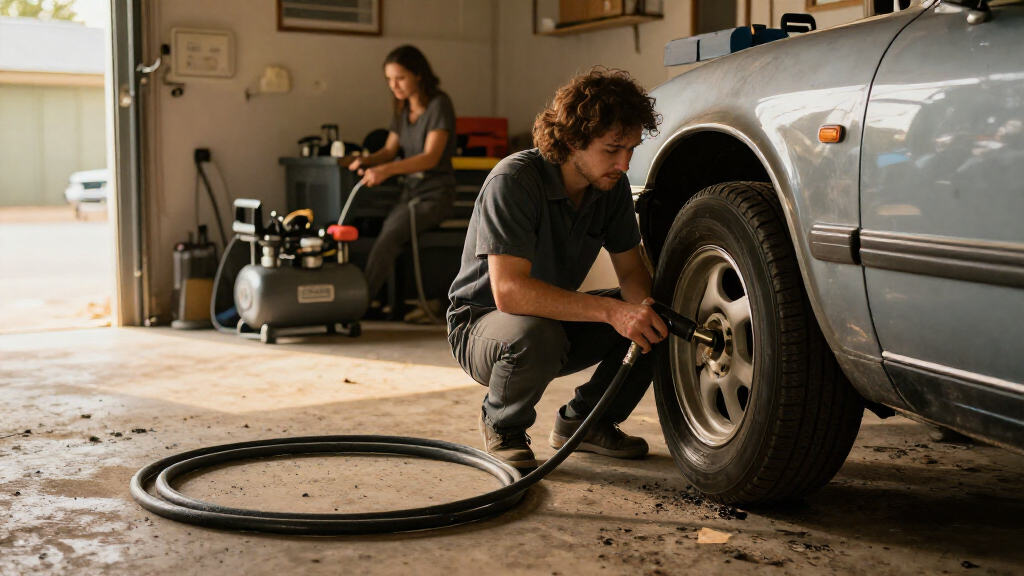

Among these garage air compressors, I would make the VEVOR 13-Gallon Oil-Free Air Compressor my best overall pick for its stated 4.6 SCFM at 90 PSI and middle-ground tank size. The California Air Tools 8010A stands out for quieter operation, while the DEWALT 60-Gallon is the stationary choice for a garage built around sustained air use. The main tradeoffs are airflow versus portability, tank capacity versus floor space, and noise versus work capacity. A larger tank can buffer short bursts, but it does not automatically make a compressor suitable for a demanding air tool. Read on for the full comparison and guidance on matching a compressor to your tools and workspace.

Get business pricing on garage and car supplies
- Business-only prices and quantity discounts
- Tax-exempt purchasing
- Multiple users, one account, clear invoices
Complete the kit


Key Takeaways
- VEVOR’s stated 4.6 SCFM at 90 PSI gives it the clearest published airflow figure among the portable mid-size choices here, making it a practical starting point for comparing tool needs.
- Tank size changes how often a compressor cycles, not its ability to sustain every tool. The 29-gallon Klutch and 20-gallon Craftsman offer more reserve than the 6-gallon ECOMAX, but airflow still determines sustained performance.
- The DEWALT 60-Gallon is a different kind of purchase from the portable options: it favors a fixed installation and longer work sessions over easy relocation.
- The California Air Tools 8010A puts noise and portability in focus with an 8-gallon aluminum tank and wheels, though its 1.0 HP motor is not the pick for buyers prioritizing high output.
- There are useful size steps across the lineup. The 2-gallon Craftsman suits light, occasional tasks; pancake and 10-gallon models add flexibility; larger tanks favor less frequent cycling and more stationary use.


| garage air compressor | Tank capacity | Maximum pressure | Noise level | Airflow |
|---|---|---|---|---|
| CRAFTSMAN 10-Gallon Oil-Free P | 10 gallons | 150 PSI | 80 dB | 4 CFM at 90 PSI; 5 CFM at 40 PSI |
| CRAFTSMAN 26-Gallon Vertical O | 26 gallons | 150 PSI | 75 dB | 5.0 CFM at 90 PSI |
| CRAFTSMAN Wall-Mount Air Compr | 0.5 gallons | 125 PSI | 65 dB | 1.8 CFM |
| ECOMAX 6-Gallon 150 PSI Oil-Fr | 6 gallons | 150 PSI | 75 dB | — |
| RyanTek 15-Gallon Oil-Free Air | 15 gallons | 125 PSI | 66 dB at 4 meters | 4.5 CFM at 90 PSI |
| VEVOR 13-Gallon Oil-Free Air C | 13 gallons | 125 PSI | 66 dB | 4.6 SCFM at 90 PSI |
| Klutch 20-Gallon Air Compresso | 20 gallons | 175 PSI | 80 dB | 4.2 SCFM at 90 PSI; 5.2 CFM maximum |
| CRAFTSMAN 2-Gallon Portable Oi | 2 gallons | 125 PSI | 78 dB | — |
| Klutch 29-Gallon Oil-Free Air | 29 gallons | 175 PSI | 81 dB | 5.1 CFM at 90 PSI |
| Craftsman 20-Gallon Oil-Free A | 20 gallons | 175 PSI | 80 dB | 4 SCFM at 90 PSI; 5 CFM maximum |
| DEWALT 60-Gallon 175 PSI Stati | 60 gallons | 175 PSI | 70 dB | 14.6 SCFM at 90 PSI |
| California Air Tools 8010A 1.0 | 8 gallons | 120 PSI | 60 dBA | — |
More Details on Our Top Picks
CRAFTSMAN 10-Gallon Oil-Free Portable Air Compressor, 1.8 HP, 150 PSI, 120V, Model CMXECXA0331042
The CRAFTSMAN 10-gallon balances useful air storage with a wheeled, folding-handle design, making it a flexible choice for garages where the compressor needs to move between tasks. Its 4 CFM at 90 PSI supports compatible nailers and other intermittent-use tools, while dual quick couplers let you connect two tools at once. Compared with the CRAFTSMAN 26-Gallon Vertical, this model is easier to reposition but holds less air and is less suited to longer work sessions. It also offers more tank capacity than the ECOMAX 6-Gallon Pancake, though the ECOMAX is more compact to carry. The oil-free pump cuts pump-oil upkeep, but the tank still needs draining, and sustained high-demand tools may outpace its supply.
Pros:- 10-gallon tank and 4 CFM at 90 PSI suit a range of intermittent garage tasks.
- Wheels and folding handle help with repositioning and storage.
- Dual quick couplers allow two compatible tools to be connected.
- Oil-free pump avoids routine pump-oil changes.
Cons:- Tank capacity may limit runtime with sustained high-air-demand tools.
- Corded 120V operation restricts use to locations with a suitable outlet.
- At 80 dB, it is not a quiet choice for noise-sensitive workspaces.
Best for: Garage owners who need a movable compressor for intermittent nailer, inflation, and general pneumatic-tool jobs.
Not ideal for: Buyers running air-hungry tools for long stretches or anyone who needs a compressor that works without a nearby 120V outlet.
- Tank capacity:10 gallons
- Motor power:1.8 HP
- Maximum pressure:150 PSI
- Airflow:4 CFM at 90 PSI; 5 CFM at 40 PSI
- Power:120 V corded electric
- Design:Vertical, portable; wheels and folding handle
- Noise level:80 dB
- Dimensions:15.3 x 16.3 x 36.6 inches
Our verdict“Choose this CRAFTSMAN for a capable, movable garage compressor that balances tank size and tool airflow without taking on a larger stationary-style unit.”
CRAFTSMAN 26-Gallon Vertical Oil-Free Air Compressor, 1.8 HP, 150 PSI
If your garage work involves repeated bursts of air, the 26-gallon vertical tank gives this CRAFTSMAN more stored air than the 10-gallon CRAFTSMAN, reducing how often the motor needs to replenish the tank during intermittent jobs. Its 5.0 CFM at 90 PSI also edges past that smaller model’s stated 4 CFM at the same pressure. The oil-free pump avoids pump-oil changes, and the vertical layout uses floor space more efficiently than a wider horizontal setup. This is still a corded 120V compressor, not a solution for continuous high-demand production work; check each tool’s airflow needs before buying. At 125.9 pounds, it is much less convenient to move than the 10-gallon model, so it makes more sense as a mostly parked garage unit.
Pros:- 26-gallon tank stores more air than the 10-gallon CRAFTSMAN model.
- Provides 5.0 CFM at 90 PSI for compatible intermittent-use tools.
- Vertical tank design keeps the footprint relatively narrow.
- Oil-free pump avoids routine pump-oil changes.
Cons:- Weighs 125.9 pounds, making frequent relocation difficult.
- Requires a corded 120V power source.
- Tank draining and other routine upkeep remain necessary.
Best for: Home mechanics and workshop owners who want a larger air reserve for intermittent tool use, inflation, and blow-off cleaning.
Not ideal for: People who regularly move their compressor around the garage, or users whose tools demand continuous airflow beyond its stated capacity.
- Tank capacity:26 gallons
- Motor power:1.8 HP
- Airflow:5.0 CFM at 90 PSI
- Maximum pressure:150 PSI
- Power:120 V corded electric; 13 A maximum current
- Pump type:Oil-free
- Weight:125.9 pounds
- Dimensions:20.3 x 19.7 x 46.9 inches
- Noise level:75 dB
Our verdict“Pick this model if a larger stored-air reserve matters more than easy mobility, but match its airflow to your tools before relying on it for extended work.”
CRAFTSMAN Wall-Mount Air Compressor with 30-Foot Retractable Hose and Accessory Kit
This wall-mounted CRAFTSMAN is aimed at garages where clear floor space matters more than a large air reserve. Its 30-foot retractable hose keeps the compressor fixed while extending reach for tire inflation and quick cleanup, a different approach from the wheeled 10-gallon CRAFTSMAN, which can be rolled to the work. The 65 dB noise rating is lower than the listed figures for the ECOMAX pancake and the 10-gallon CRAFTSMAN, which may suit a shared workspace. A 0.5-gallon tank and stated 1.8 CFM airflow, however, make this a light-duty option rather than a substitute for a larger tank when running tools for sustained periods. The included nozzles and plugs help with common garage tasks, but the listed weight is about 20.9 pounds despite the compact wall-mount format.
Pros:- Wall-mount format frees floor space.
- 30-foot retractable hose reaches around a typical garage work area.
- 65 dB listed noise level is lower than the ECOMAX pancake’s 75 dB.
- Accessory kit includes a blow gun, tire chuck, inflation needle, and nozzles.
Cons:- 0.5-gallon tank limits stored air and sustained tool use.
- Listed 1.8 CFM airflow may not meet the needs of many air-hungry tools.
- Requires a fixed corded power connection and an appropriate mounting location.
Best for: Garage owners with limited floor space who mainly inflate tires, use blow-off accessories, or need a fixed hose station.
Not ideal for: Buyers who need extended runtime for pneumatic tools or want to roll a compressor between work areas.
- Tank capacity:0.5 gallons
- Motor power:1.5 HP
- Airflow:1.8 CFM
- Maximum pressure:125 PSI
- Hose length:30 feet, retractable
- Mounting and pump:Wall mount; oil-free
- Noise level:65 dB
- Weight:20.9 pounds stated in description
Our verdict“Choose this wall-mount unit for a tidy, low-noise inflation and cleanup station, not as the main compressor for longer pneumatic-tool sessions.”
ECOMAX 6-Gallon 150 PSI Oil-Free Pancake Air Compressor with 10-Piece Accessory Kit
The ECOMAX’s 6-gallon pancake tank and 34.17-pound weight make it easier to carry than the 10-gallon CRAFTSMAN, while its flip-up handle and included kit suit occasional tire inflation, blow cleaning, and spraying. Dual quick couplers add flexibility when two compatible connections are useful. The tradeoff is that its stated airflow is listed as 3 cubic inches per minute at 90 PSI, an unusually low unit that does not support a confident comparison with the CRAFTSMAN’s 4 CFM rating. I would verify the airflow specification and confirm tool requirements before choosing it for pneumatic tools. Its oil-free pump reduces pump maintenance, but the compressor is still a corded 120V unit and its listed 75 dB noise level may be noticeable in a small garage.
Pros:- Six-gallon tank offers more stored air than the wall-mounted CRAFTSMAN’s 0.5-gallon tank.
- Flip-up handle and 34.17-pound weight support carrying and storage.
- Dual quick couplers allow two compatible tool connections.
- Includes a 10-piece kit for inflation and blow-cleaning tasks.
Cons:- Airflow is listed as 3 cubic inches per minute at 90 PSI, so tool suitability needs verification.
- At 75 dB, it may be noisy in a small or attached garage.
- Corded 120V operation limits where it can be used.
Best for: DIY garage users seeking a carryable compressor and accessory kit for tire inflation, blow cleaning, and other occasional tasks.
Not ideal for: Buyers who need dependable airflow figures for tool matching or plan to run air-hungry pneumatic tools for extended periods.
- Tank capacity:6 gallons
- Motor power:1.5 HP
- Maximum pressure:150 PSI
- Listed airflow:3 cubic inches per minute at 90 PSI
- Power:120 V corded electric
- Weight:34.17 pounds
- Noise level:75 dB
- Dimensions:16.54 x 15.94 x 19.49 inches
- Included hose:25 feet; 0.25-inch diameter
Our verdict“Consider the ECOMAX for portable, occasional garage tasks if you verify its airflow specification before connecting pneumatic tools.”
RyanTek 15-Gallon Oil-Free Air Compressor, 2 HP, 125 PSI
The RyanTek pairs a 15-gallon vertical tank with 4.5 CFM at 90 PSI, placing it between the portable 10-gallon CRAFTSMAN and the much heavier 26-gallon CRAFTSMAN in stored air and stated airflow. That makes it a plausible fit for garage users who want more reserve than a small portable unit without committing to the largest tank in this group. Its 66 dB rating at 4 meters is also lower than the listed noise figures for both CRAFTSMAN tank models. Dual outlets and an upward-facing gauge are useful when connecting tools and checking pressure. The limits are a 125 PSI ceiling, below the 150 PSI CRAFTSMAN models, and a 68.3-pound body that is wheeled but still awkward to lift. It remains corded, too.
Pros:- 15-gallon tank and 4.5 CFM at 90 PSI sit between the 10- and 26-gallon CRAFTSMAN options.
- 66 dB noise rating at 4 meters is lower than the listed ratings for those CRAFTSMAN models.
- Vertical tank, wheels, and handle support garage storage and repositioning.
- Dual air outlets and an upward-facing gauge aid tool connection and pressure checks.
Cons:- Maximum pressure of 125 PSI is lower than the 150 PSI CRAFTSMAN models.
- At 68.3 pounds, it can be difficult to lift despite its wheels.
- Corded 110V operation requires access to a suitable outlet.
Best for: Home mechanics and DIYers who want a quieter, mid-size vertical compressor for intermittent nailing, spraying, inflation, and workshop tasks.
Not ideal for: Users whose tools require more than 125 PSI, anyone needing continuous high-airflow work, or buyers who must frequently lift and carry the compressor.
- Tank capacity:15 gallons
- Motor power:2 HP
- Airflow:4.5 CFM at 90 PSI
- Maximum pressure:125 PSI
- Power:110 V corded electric
- Pump type:Oil-free, twin-cylinder
- Noise level:66 dB at 4 meters
- Weight and design:68.3 pounds; vertical, portable
- Outlets:Dual air outlets
Our verdict“Choose the RyanTek if you want a quieter mid-size tank and its 125 PSI ceiling and stated airflow match your garage tools.”
VEVOR 13-Gallon Oil-Free Air Compressor, 2 HP, 4.6 SCFM at 90 PSI
The VEVOR fills a useful middle ground for a garage that needs more reserve than a compact compressor but does not need a large vertical tank. Its 13-gallon tank and 4.6 SCFM at 90 PSI support tire inflation, nailing, and intermittent shop work, while the stated 66 dB noise level is lower than the Klutch 20-Gallon’s 80 dB and the Craftsman 20-Gallon’s 80 dB. That quieter rating may suit a home garage where noise carries into nearby rooms. The oil-free pump also cuts routine upkeep. The tradeoff is less stored air than either 20-gallon option, so it is a weaker fit for longer spray-painting sessions or other sustained airflow demands. At 71 pounds, its wheels help with rolling, but lifting it into a vehicle is still a chore.
Pros:- 13-gallon tank offers more reserve than compact portable models.
- Stated 66 dB noise level is lower than the two 20-gallon Klutch and Craftsman options.
- Oil-free design avoids routine lubrication maintenance.
- Rubber wheels make it easier to roll around a garage.
Cons:- Smaller tank than the 20-gallon and 29-gallon options limits sustained work.
- At 71 pounds, it is cumbersome to lift despite its wheels.
- Corded operation ties it to an available outlet.
Best for: Home-garage owners who want a quieter, mid-size compressor for tire work, nailing, and intermittent projects.
Not ideal for: Buyers running air-hungry tools for extended periods or anyone who needs to lift a compressor frequently.
- Tank capacity:13 gallons
- Motor:2 HP
- Airflow:4.6 SCFM at 90 PSI
- Maximum pressure:125 PSI
- Noise level:66 dB
- Power:Corded electric, 120 V
- Pump:Oil-free
- Weight:71 pounds
Our verdict“Choose the VEVOR if lower stated noise and a moderate tank matter more than the longer reserve of a 20-gallon compressor.”
Klutch 20-Gallon Air Compressor, 2 HP, 120V
The Klutch pairs a 20-gallon tank with a 2 HP motor, giving a garage more stored air than the VEVOR 13-Gallon without stepping up to the much heavier 29-gallon Klutch. Its 4.2 SCFM at 90 PSI is suited to nailing and intermittent spraying, though it is below the Craftsman 20-Gallon’s listed 4 SCFM at 90 PSI only marginally? The supplied figures show the Craftsman at 4 SCFM, so the Klutch has a slight airflow advantage; the Craftsman, however, lists 5 CFM maximum. The Klutch’s thermal overload protection and vibration-reducing feet are practical touches for a stationary garage corner, while wheels and a handle allow repositioning. Its 80 dB rating is not a quiet-workshop choice, and at 90 pounds it is portable mainly by rolling, not by carrying.
Pros:- 20-gallon tank provides more reserve than the VEVOR 13-Gallon.
- Thermal overload protection helps guard the motor against overheating.
- Rubber feet are designed to reduce vibration at its parked location.
- Wheels and ergonomic handle support rolling it around the garage.
Cons:- Stated 80 dB noise level may be disruptive in attached or noise-sensitive garages.
- At 90 pounds, moving it by lifting is difficult.
- Its 4.2 SCFM at 90 PSI is less than the 29-gallon Klutch’s 5.1 SCFM.
Best for: Garage DIYers who want a 20-gallon tank for nailing and occasional spraying, with protection features for regular home-shop use.
Not ideal for: People needing a quiet compressor, frequent lifting, or a larger airflow reserve for demanding continuous tool use.
- Tank capacity:20 gallons
- Motor:2 HP
- Airflow:4.2 SCFM at 90 PSI; 5.2 CFM maximum
- Maximum pressure:175 PSI
- Noise level:80 dB
- Power:Corded electric, 120 V
- Pump:Oil-free
- Weight:90 pounds
Our verdict“Pick this Klutch for a stable 20-gallon garage compressor when its protection and handling features matter more than quiet operation or maximum airflow.”
CRAFTSMAN 2-Gallon Portable Oil-Free Air Compressor, 1/3 HP, 125 PSI, with 10-Piece Accessory Kit
This CRAFTSMAN is the clear choice here for a small footprint and included accessories, not for supplying a full garage of air tools. The 2-gallon tank and 1/3 HP motor suit tire top-ups, brief blow-off tasks, and light fastening; the included hose, gauge, chuck, plugs, and blow gun mean a beginner has useful basics without assembling a separate kit. Compared with the VEVOR 13-Gallon or either 20-gallon compressor, it stores far less air, so repeated or sustained tool use will call for frequent recovery. Its reinforced handle and compact format make storage and short-distance carrying easier, but the listed weight conflicts: the description says 19 pounds while the specifications say 11.11 kg. I would treat that discrepancy cautiously when portability is the deciding factor.
Pros:- Compact 2-gallon tank is easier to store than the larger garage compressors.
- Includes a 10-piece accessory kit for common inflation and air tasks.
- Oil-free pump reduces routine maintenance.
- Reinforced handle supports carrying and repositioning.
Cons:- Small tank limits runtime for tools that draw air continuously.
- Listed weight is inconsistent between the product description and specifications.
- At 78 dB, it is not a quiet alternative to the VEVOR’s stated 66 dB.
Best for: First-time garage owners who mainly inflate tires and handle brief light-duty tasks, and want a ready-to-use accessory set.
Not ideal for: DIYers who plan regular spraying, extended nailing, or other tasks that need sustained airflow and a larger tank.
- Tank capacity:2 gallons
- Motor:1/3 HP
- Maximum pressure:125 PSI
- Noise level:78 dB
- Power:Corded electric, 120 V
- Pump:Oil-free
- Weight:19 lb in description; 11.11 kg in specifications
- Included accessories:Air hose, tire gauge, chuck, plugs, coupler, nozzle, blow gun, thread seal tape, and sleeve
Our verdict“Choose this compact CRAFTSMAN for occasional tire and light-duty work, not as the primary compressor for sustained garage projects.”
Klutch 29-Gallon Oil-Free Air Compressor, 2.5 HP, 120V, 175 PSI
Among these five, the 29-gallon Klutch offers the strongest stated airflow and the largest tank, making it the better fit for a garage that regularly runs pneumatic tools or wants more air reserve between recovery cycles. Its 5.1 CFM at 90 PSI exceeds the 20-gallon Klutch’s 4.2 SCFM and the Craftsman 20-Gallon’s 4 SCFM at 90 PSI. The vertical layout and flat-free tires help manage its footprint and movement, while the brass quick-connect makes hose changes simpler. This is still a 127-pound compressor, so “portable” means rolling it across a suitable floor, not lifting it into a vehicle. It is also the loudest option in this group at 81 dB. For occasional tire inflation, the smaller VEVOR is easier to place and quieter; this Klutch earns its size only when airflow and tank reserve matter.
Pros:- Largest tank in this group, at 29 gallons.
- 5.1 CFM at 90 PSI is the strongest stated airflow among these five products.
- Brass quick-connect supports convenient hose attachment.
- Flat-free wheels support rolling without tire maintenance.
Cons:- At 127 pounds, it is difficult to lift or transport without rolling.
- Stated 81 dB noise level can be disruptive in a home garage.
- Larger size needs more floor space than the 20-gallon and 13-gallon alternatives.
Best for: Garage mechanics and serious DIYers who regularly use pneumatic tools and can keep a heavy vertical compressor in the workspace.
Not ideal for: Small garages, noise-sensitive households, or buyers who need to carry a compressor up stairs or load it into a vehicle.
- Tank capacity:29 gallons
- Motor:2.5 HP
- Airflow:5.1 CFM at 90 PSI
- Maximum pressure:175 PSI
- Noise level:81 dB
- Power:Corded electric, 120 V
- Pump:Oil-free
- Weight:127 pounds
Our verdict“Choose the 29-gallon Klutch when sustained airflow and tank reserve outweigh its noise, weight, and space demands.”
Craftsman 20-Gallon Oil-Free Air Compressor, 1.8 HP, 175 PSI, Red
This Craftsman is a practical middle-ground choice for buyers who want a substantial tank without the bulk of the 29-gallon Klutch. It pairs a 20-gallon tank with listed airflow of 4 SCFM at 90 PSI and 5 CFM maximum, making it suitable for inflation, nailing, drilling, and intermittent spraying. The Klutch 20-Gallon lists 4.2 SCFM at 90 PSI and adds thermal overload protection, so it has a small stated airflow lead and more explicitly described protection; the Craftsman counters with two quick couplers, useful when switching between tools without repeatedly changing connections. Rubber wheels and a ball drain valve add everyday garage convenience. Its 80 dB rating matches the Klutch 20-Gallon’s stated noise level, and the 120-volt corded setup limits where it can run.
Pros:- 20-gallon tank supports longer use than compact compressors such as the 2-gallon CRAFTSMAN.
- Two quick couplers make it easier to connect or switch between tools.
- Oil-free pump reduces routine maintenance.
- Rubber wheels and ball drain valve add practical garage convenience.
Cons:- Stated 80 dB noise level may be loud for an attached garage.
- Corded 120-volt operation requires a nearby suitable outlet.
- Its 4 SCFM at 90 PSI is below the 29-gallon Klutch’s 5.1 CFM at 90 PSI.
Best for: Home mechanics and DIYers who want a 20-gallon tank, multiple quick connections, and airflow for varied intermittent garage tasks.
Not ideal for: Buyers who need quieter operation, cordless placement, or the higher stated airflow and larger reserve of the 29-gallon Klutch.
- Tank capacity:20 gallons
- Motor:1.8 HP
- Airflow:4 SCFM at 90 PSI; 5 CFM maximum
- Maximum pressure:175 PSI
- Noise level:80 dB
- Power:Corded electric, 120 V
- Pump:Oil-free
- Included connections:Two quick couplers
Our verdict“Choose this Craftsman for versatile intermittent garage work and two tool connections, but step up to the 29-gallon Klutch for greater airflow and reserve.”
DEWALT 60-Gallon 175 PSI Stationary Electric Air Compressor
For a garage set up around air tools, this 60-gallon tank and output of 14.6 SCFM at 90 PSI put the DEWALT in a different class from portable options such as the California Air Tools 8010A. The larger reserve and higher airflow are better suited to supporting demanding shop or automotive work with fewer interruptions for pressure recovery. Its vertical stationary design also uses floor space more efficiently than a wide portable unit.
The tradeoff is the installation: this compressor needs 240-volt power and a recommended 30-amp double-pole breaker, and no power cord is included. At 70 dB, it is not as quiet as the 8010A, either. I’d rank it for garages with the electrical setup and room for a fixed compressor, not for buyers who need something they can roll between jobs.
Pros:- 14.6 SCFM at 90 PSI supports higher-demand air-tool use.
- 60-gallon tank provides a substantial air reserve for longer work sessions.
- Vertical configuration makes better use of floor space than a horizontal tank.
- Includes a large air outlet port, pressure gauge, and on/off switch.
Cons:- Requires 240-volt power and an appropriate electrical installation.
- Power cord is not included.
- Stationary size and 70 dB operating noise make it less suited to shared or compact workspaces.
Best for: Home-shop owners and automotive DIYers who run air tools regularly and have space and suitable 240-volt electrical service for a stationary compressor.
Not ideal for: Renters, small garages, and occasional users who need a portable plug-in unit or cannot accommodate the required 240-volt installation.
- Tank capacity:60 gallons
- Maximum pressure:175 PSI
- Airflow:14.6 SCFM at 90 PSI
- Motor:5 HP
- Voltage:240 V
- Recommended breaker:30 A double-pole
- Noise level:70 dB
- Configuration:Vertical
Our verdict“Choose this DEWALT for a fixed garage shop that needs substantial airflow and tank capacity, and skip it if portability or standard 120-volt power is a priority.”
California Air Tools 8010A 1.0 HP Ultra-Quiet Oil-Free Air Compressor, 8-Gallon Aluminum Tank with Wheels
The California Air Tools 8010A makes the strongest case for a quieter, movable garage compressor: its 60 dBA rating is well below the DEWALT 60-Gallon’s 70 dB, making it more comfortable for noise-sensitive indoor jobs. At 37.25 pounds, with a wheel kit and an aluminum tank, it is also easier to reposition than that stationary DEWALT. The oil-free dual-piston pump avoids routine oil changes, while the 120-volt supply fits a more typical garage outlet.
Its limits show up when a job needs sustained airflow. Output is 2.20 CFM at 90 PSI and the tank holds 8 gallons, so it is better suited to intermittent tasks such as nailing, air brushing, and blow cleaning than extended high-demand tool use. Compared with the larger CRAFTSMAN 10-Gallon portable model, this one prioritizes lower noise and easier movement over tank capacity. It still needs a corded outlet and is not a substitute for a shop-scale compressor.
Pros:- 60 dBA operation is quieter than the DEWALT 60-Gallon and suited to noise-sensitive spaces.
- Wheel kit and 37.25-pound weight make it easier to move around a garage.
- Oil-free dual-piston pump requires no oil changes.
- Aluminum tank helps keep the portable unit lighter than a comparable steel-tank design.
Cons:- 2.20 CFM at 90 PSI and an 8-gallon tank limit sustained use with high-airflow tools.
- Requires a corded 110-volt AC power source.
- Its 120 PSI maximum pressure and portable capacity do not match the DEWALT’s shop-scale output.
Best for: Garage users who need to move a compressor between work areas and run intermittent tools, inflate tires, or clean parts without excessive operating noise.
Not ideal for: Users who run air-hungry tools for long periods or work far from an electrical outlet; its 8-gallon tank and corded 110-volt supply limit those uses.
- Tank capacity:8 gallons
- Tank material:Aluminum
- Pump type:Oil-free dual-piston
- Airflow at 90 PSI:2.20 CFM
- Airflow at 40 PSI:3.10 CFM
- Maximum pressure:120 PSI
- Noise level:60 dBA
- Weight:37.25 lbs
- Voltage:110 V AC
Our verdict“Pick the 8010A for quieter portable garage jobs and intermittent tool use, but choose a larger compressor if you need sustained airflow.”
How We Picked
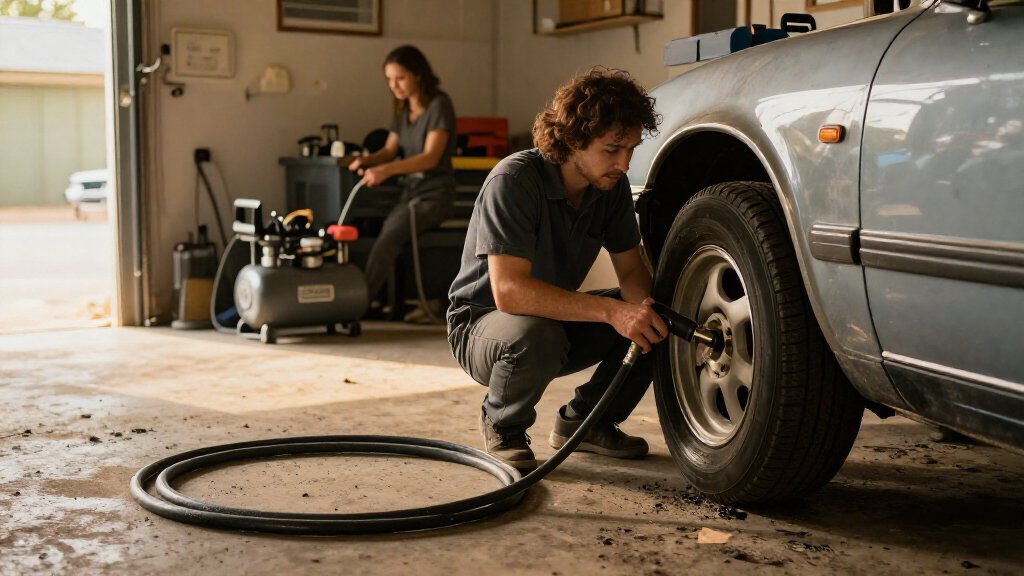
I ranked these garage air compressors by how well their stated specifications and design match common home-garage jobs. The main criteria were air delivery at working pressure, tank capacity, portability, power requirements, noise-related design details, and the practical footprint of each unit. I gave more weight to published airflow than to tank size alone because tools such as sanders and spray equipment can demand continuous air that a bigger tank cannot supply indefinitely.
The ranking favors a useful balance for a typical garage, then separates products by distinct needs: low noise, light-duty portability, larger air reserve, or fixed high-capacity use. Where the provided product information does not state an airflow figure or noise level, I do not treat that specification as a proven advantage. Buyers should compare a tool’s required SCFM at its working PSI with the compressor’s delivered airflow before choosing, especially for sustained-use tools.
Factors to Consider When Choosing Garage Air Compressors
I would start with the tools and work pattern, not the biggest tank or highest PSI on the label. These choices range from a compact 2-gallon unit to a stationary 60-gallon model, so the right fit depends on air demand, available space, and how often you need to move the compressor.
Match Airflow to Your Tools
Check each tool’s stated SCFM requirement at its working PSI, then compare it with the compressor’s delivered airflow at that pressure. Short bursts from an inflator or brad nailer place different demands on a compressor than a sander or spray gun running continuously. A high PSI figure alone does not tell you how long the unit can keep a tool running. If the compressor’s airflow falls short, the tank may provide a temporary buffer, followed by pauses while pressure recovers. For a mix of tools, use the most air-hungry tool you expect to run for extended periods as your sizing reference. If airflow data is missing, treat that as an information gap rather than assuming a larger tank makes up for it.
Choose Tank Capacity for Your Work Rhythm
A larger tank stores more compressed air, which can reduce how frequently the motor cycles during intermittent jobs. It does not raise the compressor’s sustained air-delivery capacity, so tank size should not be used as a substitute for an adequate SCFM rating. Small tanks can make sense when tasks are brief and the unit needs to stay easy to carry or store. Mid-size tanks offer a compromise for general garage tasks, while large tanks are better suited to fixed work areas and repeated air use. Think about whether you prefer a compact machine that cycles more often or a larger unit that takes up more space. Also leave access for draining condensation, since a tank that is hard to reach is easier to neglect.
Plan for Noise and Where the Compressor Will Sit
Noise matters more when the garage is attached to the home, shares a wall with living space, or sees frequent compressor use. Do not assume that oil-free means quiet; motor design and the manufacturer’s stated noise level are more useful guides. A quieter model can make routine tasks more comfortable, but buyers should check whether its output suits their tools before choosing it for sound alone. Placement also affects usability: a portable unit can move closer to the job, while a wall-mounted design can free floor space if the wall and hose path suit the layout. Large stationary compressors need a planned location, room for service access, and a suitable power connection. Consider hearing protection and household noise tolerance as part of the purchase, not an afterthought.
Check Power, Installation, and Space Before Buying
Confirm the compressor’s voltage and electrical requirements against the outlet and circuit available in your garage. A 120V unit may be simpler to place in a typical home workspace, but that does not establish that every circuit can support its startup and running demands. Larger stationary models can require more planning around wiring, ventilation, and a permanent location. Measure doorways, storage areas, and the route from delivery to the final spot, especially for tall vertical tanks. Leave room to reach the drain, controls, and fittings, and check whether the compressor’s footprint conflicts with cars or benches. A unit that fits the available power and space is more useful than one whose capacity cannot be installed conveniently.
Weigh Portability Against Capacity
Wheels and a manageable tank size help when the compressor needs to move between a garage bay, driveway, and storage area. They do not make a heavier machine effortless to lift, so consider thresholds, stairs, and how often you will relocate it. Compact pancake and small-tank designs prioritize storage and quick setup, while larger tanks trade mobility for greater stored-air reserve. A wall-mounted model can keep the floor clear, though its fixed location and hose reach need to fit the work area. Before buying, map where the compressor will sit and where the hose must reach; a long hose can add convenience but may also affect pressure at the tool. Choose based on your actual workflow rather than assuming portability is always worth a capacity compromise.
Budget for Maintenance and Future Tools
Oil-free models reduce the need for oil changes, but they still need routine care, including tank draining and attention to filters and fittings. Ask how easy it will be to reach service points and find replacement parts for the model. Think about tools you may add later: a compressor that handles inflation and occasional nailing may not suit a future spray gun or air sander. Paying more for a larger or stationary unit makes sense only if the workspace, electrical supply, and regular tool use support that capacity. On the other hand, buying too small can lead to repeated pauses or an eventual replacement. Compare the whole setup—compressor, hose, couplers, and any required electrical work—not only the machine’s headline specifications.
Frequently Asked Questions
Can a larger tank replace a higher SCFM rating?
No. A larger tank stores more air and can help cover short periods of demand, but the compressor still has to replenish that air at a rate its pump can sustain. A tool with continuous air demand can drain even a large tank if the compressor’s delivered SCFM is too low. Compare the tool’s air requirement at its working pressure with the compressor’s rated delivery at the same pressure. For intermittent tasks, extra tank capacity may reduce cycling; for sustained work, prioritize airflow.
Is a 120V compressor suitable for a typical home garage?
It can be a convenient match for a home garage, but the voltage label alone does not confirm that a particular outlet or circuit is suitable. Check the compressor’s electrical specifications and compare them with the circuit capacity, wiring, and other loads on that circuit. Larger motors can draw substantial current when starting, so avoid assuming an extension cord or shared circuit will work. If the electrical requirements are unclear, ask a qualified electrician before installation. This check is especially relevant when moving from a small portable model to a larger tank compressor.
Should I choose an oil-free compressor for garage use?
Oil-free construction can reduce routine maintenance and simplify ownership for occasional home projects. It does not automatically mean quieter operation, longer life, or better air delivery, so compare those qualities separately. Buyers who prioritize simple upkeep may prefer oil-free designs, while frequent users should also check service guidance, duty-cycle information, and parts availability. Tank draining and general inspection still matter regardless of pump type. Choose based on how often you will use the compressor and what upkeep you are comfortable doing.
When does a stationary 60-gallon compressor make more sense than a portable model?
A stationary compressor is a better fit when the garage has a permanent work area, suitable electrical service, and recurring jobs that benefit from a larger air reserve. It is less appealing if you need to move equipment around, share floor space with vehicles, or avoid installation work. Before choosing one, confirm its electrical needs, location, ventilation, and service access. Also check its airflow against the tools you plan to run, since a large tank by itself does not establish sustained tool compatibility. For occasional inflation and short bursts, a portable unit may be easier to live with.
What should I prioritize if I want one compressor for several different tools?
Start by identifying the tool with the highest sustained air demand, then compare its SCFM requirement at the working PSI with the compressor’s delivered airflow. Next, check whether your other tools need different pressure ranges, fittings, or a regulator. A general-purpose setup also benefits from a hose long enough to reach the work area without forcing the compressor into an inconvenient spot. If the expected tools have very different demands, it may be better to choose for the most demanding regular task and use the compressor for lighter tasks as well. Avoid relying on an accessory kit or a high maximum PSI as proof that every air tool will run well.
Conclusion
For a typical garage that needs a balance of tank capacity and stated airflow, I would choose the VEVOR 13-Gallon as best overall, while confirming its output against the tools I plan to run. The ECOMAX 6-Gallon is the value-minded option for lighter, intermittent tasks, and the California Air Tools 8010A is my pick for buyers who put quieter operation and a wheeled aluminum tank high on the list. Beginners with modest needs can start with the CRAFTSMAN 2-Gallon for compact, occasional use, but should skip it if they expect sustained tool operation. For a premium, fixed-workshop setup, the DEWALT 60-Gallon suits buyers prepared for the space and electrical planning; the CRAFTSMAN wall-mount model better serves garages where clearing floor space matters. Choose by airflow, installation fit, and work pattern—not tank size alone.
Evergreen bestsellers Picks

Dyson V15 Detect Cordless Stick Vacuum

Bose QuietComfort Wireless Noise-Cancelling Headphones, Twilight Blue

Dyson V8 Cyclone Cordless Vacuum
As an affiliate, we earn on qualifying purchases.