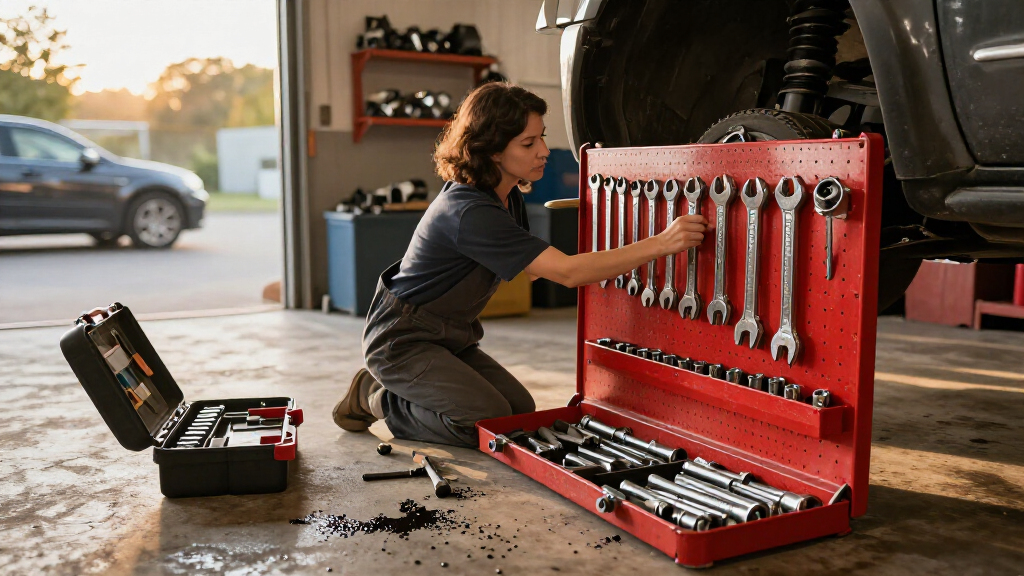

Choosing garage organization tools often comes down to a practical tradeoff: should frequently used equipment stay visible on the wall, or should it be stored behind doors in cabinets? A wall-mounted system uses rails, hooks, shelves, and holders to put tools within reach and leave the floor open. Freestanding cabinets offer enclosed storage for supplies, power tools, and items that benefit from protection from dust or casual view.

Get business pricing on garage and car supplies
- Business-only prices and quantity discounts
- Tax-exempt purchasing
- Multiple users, one account, clear invoices

POKIPO Large Power Tool Organizer Wall Mount with Charging Station – 4-Layer Heavy-Duty Metal Rack (600 lb capacity) with 8 Drill…
- ✔ Load capacity: 600 lb
- ✔ Shelves: 4 tiers
- ✔ Drill holders: 8 slots

OEMTOOLS 26052 4-Pc Collapsible Magnetic Tray Set 4-1/2" for Small Parts
- ✔ Set size: 4 trays
- ✔ Expanded dimensions: 4.5 in square, 2 in deep
- ✔ Folded height: 0.75 in

Power Tool Organizer Wall Mount, 4-Tier Heavy-Duty Tool Storage Rack
- ✔ Load capacity: 400 lb
- ✔ Shelves: 4 tiers
- ✔ Material: Alloy steel
The better choice depends on what you store and how you work. Wall storage usually suits homeowners who want fast access to everyday tools and need to reclaim floor space. Cabinets make more sense when a garage contains many small items, hazardous supplies, or equipment that should be kept out of sight. Both can work together, but if you are choosing one first, the main question is whether visibility and floor clearance matter more than enclosed capacity.
At a Glance
| Criteria | Wall-mounted garage organization system | Freestanding garage storage cabinets | Winner |
|---|---|---|---|
| Access to frequently used tools | Tools stay visible and can be reached directly from hooks or holders. | Doors and drawers add a step before tools can be reached. | A |
| Protection and concealment | Open storage exposes tools and supplies to dust and view. | Enclosed compartments conceal contents and reduce exposure to dust. | B |
| Use of floor space | Uses wall area and keeps most stored items off the floor. | Cabinet footprint takes floor area, though vertical models can use height. | A |
| Storage capacity | Strong for hand tools and frequently used gear; bulky items need suitable hooks or shelves. | Strong for grouped supplies, small parts, and items that need shelves or drawers. | Depends |
| Flexibility as needs change | Hooks and accessories can often be repositioned along compatible rails. | Internal layouts can be adjusted, but moving a loaded cabinet is difficult. | A |
| Installation and setup | Requires secure wall attachment and planning around studs, wall type, and tool weight. | Usually simpler to place, though heavy units may need anchoring and assembly. | A |
| Value for typical garage use | Often a strong first purchase for commonly used tools and tight floor plans. | Worth the extra cost when protected, concealed, or compartmentalized storage matters. | Depends |
POKIPO Large Power Tool Organizer Wall Mount with Charging Station – 4-Layer Heavy-Duty Metal Rack (600 lb capacity) with 8 Drill…
The POKIPO is the most complete choice when an automotive garage needs a permanent home for drills and their accessories. Its four-tier metal layout combines shelves, bit racks, hooks, and eight drill slots, so it can gather tools that otherwise occupy a bench or get scattered across the floor. The stated 600-pound capacity is the highest among the two wall racks in this roundup, making it the stronger fit for a substantial collection, provided the wall and installation can support the load.Its practical distinction is the integrated four-outlet power strip and 6.5-foot cord. Compared with the modular 400-pound rack, POKIPO makes charging part of the storage setup, which can help keep cordless tools together between jobs. Compared with the OEMTOOLS trays, it is built for larger equipment and ongoing workshop organization rather than carrying parts to a specific repair.That capacity and breadth come with a footprint. The rack needs considerable wall area, and installation requires drilling into the mounting surface. It is also described for indoor use, so its metal construction should not be taken as a reason to install it outdoors. Choose it when the garage has a suitable wall and power access; skip it if you only need to corral fasteners or have little wall space to spare.
Pros:
- Four tiers combine shelves, bit racks, hooks, and eight drill slots.
- Integrated four-outlet strip and 6.5-foot cord support charging at the rack.
- Highest stated capacity among the wall racks in this comparison, at 600 pounds.
- Mounting is described for wood, concrete, or pegboard surfaces.
Cons:
- Bulky layout can consume valuable wall space in a compact garage.
- Installation requires drilling and a mounting surface suited to the intended load.
- Specified for indoor use only.
Best for: Automotive DIYers with several drills and accessories who want a dedicated wall-mounted charging and storage station.
Not ideal for: Garage owners with limited wall space, renters unable to drill, or mechanics whose main organization problem is small fasteners rather than power tools.
Bottom line: For a garage that can accommodate a permanent station, POKIPO offers the best blend of drill storage, accessory organization, and on-rack charging.
“For a garage that can accommodate a permanent station, POKIPO offers the best blend of drill storage, accessory organization, and on-rack charging.”
OEMTOOLS 26052 4-Pc Collapsible Magnetic Tray Set 4-1/2" for Small Parts
During an automotive repair, loose bolts and clips can disappear into the same crowded work surface as sockets and tools. The OEMTOOLS set addresses that small but persistent problem with four magnetic trays that can be assigned to different parts or steps in a job. Their green, blue, red, and orange colors make the groups easier to distinguish at a glance, while the magnetic bases help keep trays attached to suitable metal surfaces.Unlike either wall rack, these trays move with the work and do not require wall space or permanent installation. They expand to a two-inch depth and hold up to two pounds each, enough for many small fasteners from a repair. When the job is over, the trays fold to three-quarter-inch height, which makes them easier to store than rigid parts bins. That portability is their main advantage over the POKIPO and modular rack, both of which organize larger equipment in a fixed location.The role is deliberately narrower. Four trays provide only four sorting categories, and the two-pound limit per tray can be restrictive for a large teardown or heavier components. The set will not clear a bench of drills or hand tools. We would choose it alongside an existing wall-storage system when keeping parts controlled matters most; buyers seeking a full garage organization solution should look to one of the racks instead.
Pros:
- Four color-coded trays help separate parts by type or repair step.
- Magnetic bases can hold trays to compatible metal surfaces.
- Collapsible design folds flat for compact storage.
- Two-inch expanded depth accommodates many small automotive fasteners.
Cons:
- Each tray is limited to a two-pound capacity.
- Four trays may not provide enough categories for complex jobs.
- Does not organize larger tools or reclaim wall storage space.
Best for: Mechanics and DIYers who want to separate fasteners and small parts during automotive repairs, then store the trays compactly.
Not ideal for: Anyone seeking storage for drills, bulky hand tools, or a large volume of hardware, or needing more than four sorting groups.
Bottom line: For portable control of nuts, bolts, and clips, this set is the most focused option here, but it complements rather than replaces a tool rack.
“For portable control of nuts, bolts, and clips, this set is the most focused option here, but it complements rather than replaces a tool rack.”
Power Tool Organizer Wall Mount, 4-Tier Heavy-Duty Tool Storage Rack
This rack is the better match when the garage needs adaptable wall storage for a changing mix of tools. Its four shelves, modular pegboards, drill slots, and adjustable hooks let owners arrange storage around what they actually keep on hand, from power tools to accessories and hand tools. The stated capacity is 400 pounds, below the POKIPO’s 600 pounds, but still substantial on paper for a wall-mounted organizer.Compared with POKIPO, the modular system emphasizes customization over an integrated charging setup. There is no power strip listed, so charging must happen elsewhere; in return, adjustable hooks and pegboards provide more freedom to change the layout. It also differs from the OEMTOOLS set in scale: this rack is intended to organize equipment in a fixed workshop position, while the trays follow small parts to the job.The product description calls assembly tool-free and includes mounting hardware, but that does not remove the need to anchor it securely. The full capacity depends on sound mounting, and uneven or non-standard walls can make installation challenging. Its indoor designation also matters despite the listed corrosion- and rust-resistant properties. Choose this model when configurable wall storage is the priority; consider POKIPO if on-rack charging and the higher stated load capacity are more useful.
Pros:
- Modular pegboards and adjustable hooks support a customizable arrangement.
- Four-tier layout accommodates several types of workshop tools.
- Stated 400-pound capacity suits substantial storage when properly anchored.
- Description includes mounting hardware and calls assembly tool-free.
Cons:
- No integrated power strip is listed, unlike the POKIPO rack.
- Full stated capacity depends on secure anchoring, which may be difficult on uneven walls.
- Indoor-use designation limits placement despite the listed resistance properties.
Best for: DIYers or tradespeople who want customizable wall storage for a mixed collection of power tools, accessories, and hand tools.
Not ideal for: Buyers who want charging outlets built into the rack, need the higher stated capacity of POKIPO, or cannot anchor a rack securely to their wall.
Bottom line: This is the sensible alternative when adjustable wall layout matters more than integrated charging or the highest stated capacity.
“This is the sensible alternative when adjustable wall layout matters more than integrated charging or the highest stated capacity.”
As an Amazon Associate we earn from qualifying purchases.
Key Differences
The clearest difference is how each system handles access. A wall-mounted setup makes everyday items easy to see and grab, which helps when switching between repairs or returning tools after use. The tradeoff is exposure: open hooks and shelves do little to conceal clutter or shield supplies from dust. Cabinets reverse those priorities. Doors create a tidier appearance and help contain small items, but users must open them and remember where each item belongs.
Space and capacity also point in different directions. Wall storage leaves the floor clear, which matters in a one-car garage, a workshop with rolling equipment, or any space that doubles as a parking area. Cabinets can store a broad mix of supplies behind a consistent front, but their footprint competes with vehicles, benches, and storage bins. For many garages, a practical setup starts with wall storage for daily tools and adds a cabinet only for supplies that benefit from being enclosed.
Detailed Comparison
Access to frequently used tools (Wall-mounted garage organization system wins — moderate)
Winner: A, by a moderate margin. Hooks, racks, and holders make commonly used tools visible and immediately available. With cabinets, users must open doors or drawers, and small tools can be harder to locate unless compartments are labeled and maintained. For repeated tasks, the wall system saves small amounts of time throughout the week. Cabinets remain convenient for tools used less often or stored in clearly organized drawers.
Protection and concealment (Freestanding garage storage cabinets wins — major)
Winner: B, by a major margin. Cabinet doors keep contents out of sight and offer a degree of protection from ordinary dust and incidental contact. Wall storage displays everything and leaves supplies exposed. Neither option should be treated as a substitute for proper chemical storage or a secure, rated enclosure where one is required, but cabinets are the more sensible choice for keeping household products, small parts, and clutter contained.
Use of floor space (Wall-mounted garage organization system wins — major)
Winner: A, by a major margin. Wall-mounted storage puts tools on otherwise unused vertical space and keeps the floor available for parking, a workbench, or moving larger equipment. A freestanding cabinet occupies floor area even when it uses height efficiently. In a compact garage, that footprint can be the difference between a clear walkway and a cramped one. A cabinet can still be a good fit where there is a dedicated storage wall or unused corner.
Storage capacity (moderate difference)
Winner: Depends on what needs storing. Cabinets usually hold more small, mixed items in one organized footprint because shelves and drawers contain loose supplies. Wall systems make better use of linear wall space for long-handled tools, cords, and frequently used equipment. The advantage is moderate rather than universal: compare the actual cabinet volume and wall layout against your inventory. Large or awkward tools may not fit neatly in either system without dedicated holders.
Flexibility as needs change (Wall-mounted garage organization system wins — minor)
Winner: A, by a minor margin. Compatible hooks and accessories can often be moved as a tool collection changes, making wall systems easy to reconfigure. Cabinet shelves can also be adjusted, but the cabinet itself is harder to relocate once loaded, and its dimensions set the storage boundaries. The practical gap is small if the cabinet has adjustable shelves and will stay in one place; it grows when the garage layout changes often.
Installation and setup (moderate difference)
Winner: A for long-term wall use, B for a simple initial setup. A cabinet can often be assembled and placed without planning an entire wall layout, although heavy units may need anchoring for stability. Wall systems require suitable fasteners and careful attachment to the wall structure, especially for heavy tools. That makes the initial installation more demanding, but once securely installed, adding or moving compatible accessories is straightforward. The gap is moderate and depends on wall construction and the system chosen.
Value for typical garage use (moderate difference)
Winner: Depends on the problem being solved. A wall system is often better value when the main goal is clearing the floor and organizing tools used every week. Cabinets justify their cost when concealment, dust reduction, or drawers for small parts solve a real problem. Paying more for cabinet volume alone may not help if floor space is already scarce; paying for a well-built cabinet makes sense when it protects or organizes items that otherwise remain scattered.
Wall-mounted garage organization system: Pros and Cons
Pros:
- Keeps common tools visible and quick to reach.
- Frees floor space for parking and larger equipment.
- Accessories can often be rearranged as tool needs change.
- Works well for long-handled tools and frequently used gear.
Cons:
- Tools and supplies remain exposed to dust and view.
- Loose small parts need separate bins or another storage method.
- Secure installation requires suitable wall attachment.
- The wall can look cluttered if tools are not grouped carefully.
Freestanding garage storage cabinets: Pros and Cons
Pros:
- Conceals clutter and groups supplies behind doors or drawers.
- Provides contained storage for small parts and mixed items.
- Can reduce ordinary dust exposure compared with open shelves.
- Often easier to place without designing a full wall layout.
Cons:
- Uses floor space that may be needed for a vehicle or work area.
- Tools take longer to retrieve than items on open hooks.
- Loaded cabinets can be difficult to move.
- The interior can become disorganized without a consistent layout.
Who Should Choose What
Choose Wall-mounted garage organization system if:
- You reach for the same hand tools or yard equipment every week.
- Your garage floor needs to stay clear for parking or rolling equipment.
- You want to see what you own and can attach the system securely to the wall.
- Your storage needs change often and you value movable hooks and holders.
Choose Freestanding garage storage cabinets if:
- You need to hide visual clutter or keep supplies less exposed to dust.
- You store many small parts, household products, or tools that benefit from drawers and shelves.
- Your garage has a stable area where a cabinet footprint will not obstruct parking or work.
- You prefer a contained storage setup and will keep a consistent place for each item.
Skip both if: If the garage has no safe wall space and no room for a cabinet footprint, start by reducing or relocating stored items, then choose compact portable bins or storage elsewhere.
Value for Money
Wall storage is usually the stronger value when the main goal is to organize everyday tools without sacrificing floor area. A basic rail or hook setup can solve a frequent-access problem without requiring a large cabinet purchase. Its value falls if the garage needs concealed storage for loose parts or supplies, since those items may still require bins or drawers.
Pay more for cabinets when enclosure and compartments will change how you use the space: for example, when small supplies keep spilling across a bench, or when you want a tidier garage and have room for the unit. The extra cost is harder to justify if you mainly need to hang a few tools or preserve parking clearance. For many households, a modest wall system is the best starting investment, with one cabinet added later for items that do not belong on open display.
Final Verdict
Choose a wall-mounted garage organization system for the better all-around starting point in most active garages. It keeps everyday tools accessible and protects valuable floor space, making it the clearer choice for homeowners who work in the garage or still need to park a vehicle there. Choose freestanding cabinets when concealment, compartments, and reduced dust exposure matter more than floor clearance. The deciding factor is what you store most: tools you use often favor the wall; loose supplies and clutter favor a cabinet. Paying more for enclosed storage makes sense only when that protection and order solve a specific problem.
Frequently Asked Questions
Which garage storage option is better for a small garage?
A wall-mounted system is usually better when floor space is limited because it keeps tools off the ground. A compact cabinet can still work if it fits a corner without reducing parking or walkway space.
Do cabinets protect tools from dust?
Closed doors reduce ordinary dust exposure compared with open hooks and shelves, but the degree of protection depends on the cabinet construction and how tightly it closes. Neither option should be treated as sealed storage unless the product is designed for that purpose.
Are wall-mounted systems difficult to install?
They require secure attachment to a suitable wall structure, with fasteners appropriate for the wall and expected load. Planning the layout takes effort, particularly for heavy equipment, but compatible hooks and holders are generally easier to rearrange after installation.
Can wall storage and cabinets be used together?
Yes. A practical combination is wall hooks for everyday tools and a cabinet for small parts, supplies, or items you prefer to keep concealed. This uses vertical space for quick access while reserving the cabinet for things that benefit from enclosure.