
TL;DR
Tesla is rolling out Emergency Drive Away, a software feature that lets eligible vehicles shift into Drive and leave a U.S. Supercharger while still connected. Tesla says the breakaway connector and departure can damage both the vehicle and charger, and the feature is intended for emergencies only.
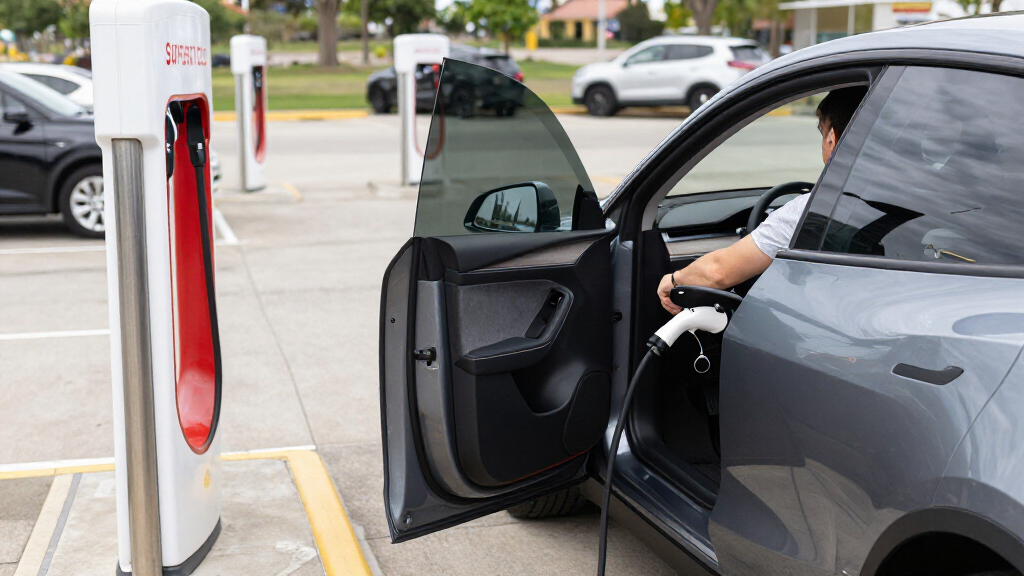
Tesla is rolling out Emergency Drive Away, a software feature that allows eligible vehicles to shift into Drive and leave a Supercharger while the charging cable is still connected. Announced by the Tesla Charging account on X, the feature is intended for emergencies, but Tesla warns that using it will damage the vehicle and charger.

Get business pricing on garage and car supplies
- Business-only prices and quantity discounts
- Tax-exempt purchasing
- Multiple users, one account, clear invoices
To activate it, a driver shifts into Drive while plugged in and confirms an alert on the touchscreen. Tesla’s demonstration shows the charging connector breaking away as the car pulls forward, leaving part of the connection on the ground. The demonstration indicates that leaving this way is not damage-free.
Tesla says the feature is rolling out over the air and requires software version 2026.38.3. It is limited to U.S. Superchargers and is not available on pre-2021 Model S sedans or Model X crossovers. Tesla also warns of additional penalties for deliberate misuse.
The Drive reported that the feature follows a lethal shooting at a Tesla Supercharger in Idaho this summer. The available source does not provide further details about the shooting or establish that the update would have changed the outcome. Tesla’s announcement describes a way to leave while connected, not an automated unplugging system.
Leaving Without Unplugging
The feature gives drivers of supported vehicles another option if they believe they need to leave a charging site immediately and cannot or do not have time to disconnect the cable normally. That may matter in an emergency where remaining at the stall feels unsafe. The Idaho shooting is the reported impetus for the update, but the source material does not establish how Emergency Drive Away would apply to specific incidents.
The trade-off is clear: this is an emergency override, not a routine departure method. Tesla says driving away while connected will damage both the vehicle and the Supercharger. Drivers also may face additional penalties if they misuse the feature deliberately. Its practical value therefore depends on a genuine urgent need, not simply convenience.
Products Worth Considering

Autel 50A Level 2 Hardwired EV Charger with 25 ft J1772 Cable

Autel MaxiCheck MX808S Bidirectional OBD2 Diagnostic Scanner

Chemical Guys 16-Piece Ceramic Car Wash and Protection Kit with Big Mouth Foam Cannon
As an affiliate, we earn on qualifying purchases.
A Software-Based Emergency Override
Tesla distributes vehicle software updates over the air, allowing some features to be added without a service visit. The company has used that approach for other vehicle functions; this update applies it to the charging connection by allowing a supported car to override the usual shift lockout while the cable remains attached.
The connector’s breakaway behavior is part of how the car can move, but Tesla’s demonstration shows a component falling to the ground. The report also notes that Tesla has developed a robotic charging arm, but says it was not put into production. Emergency Drive Away does not provide automatic cable removal or remove the need for drivers to assess the situation.
“Emergency Drive Away”
— Tesla Charging account on X
Limits and Damage Details
The available report does not specify how much damage typically occurs, what parts may need repair, or how Tesla will determine whether a use was deliberate. It also does not provide a complete list of eligible models beyond excluding pre-2021 Model S and Model X vehicles, or say how quickly the update will reach every eligible car.
The report links the feature’s development to the Idaho shooting, but does not give details about the incident or say that Tesla designed the feature in response to a particular failure to escape. It remains unclear whether Tesla plans to expand availability beyond U.S. Superchargers or add a method for disconnecting without damage.
Update Availability and Use
Eligible owners will need to receive software version 2026.38.3 before they can use Emergency Drive Away. Tesla has described the update as rolling out now, but the source does not give a schedule for individual vehicles or announce availability outside the United States.
For now, Tesla’s stated guidance is to reserve the override for emergencies and expect damage if it is used. Further details about rollout timing, repair consequences, and any expansion of the feature have not been announced in the source material.
Key Questions
What does Tesla Emergency Drive Away do?
It lets an eligible Tesla shift into Drive and leave a Supercharger while the cable is still connected, after the driver confirms an alert on the touchscreen.
Which software version is required?
Tesla says the feature requires software version 2026.38.3.
Which vehicles and chargers are supported?
The feature is limited to U.S. Superchargers and is unavailable on pre-2021 Model S sedans and Model X crossovers. The source does not provide a complete eligibility list.
Will driving away while plugged in damage the car?
Yes. Tesla warns that using the feature will damage both the vehicle and the Supercharger, and says deliberate misuse may lead to additional penalties.
Can the feature unplug the car without damage?
No such capability is described. Emergency Drive Away allows the vehicle to pull away while connected; Tesla’s demonstration shows the connector breaking away and a component falling to the ground.
Source: rss