
TL;DR
Tesla has shared more details about the Cybercab’s “unboxed” production process at its Texas factory. Major vehicle sections are assembled and tested on separate lines, then joined with much of their wiring and interior already installed; Tesla says the line is about 78% automated and can produce up to 125,000 vehicles a year.
Tesla has revealed more about how its Texas factory builds the Cybercab, using a production method that assembles and tests major vehicle sections separately before joining them near the end of the process. In a video tour with engineers from Munro & Associates, Tesla described a line it says is about 78% automated, designed to reduce the steps and factory space needed for assembly.

Get business pricing on garage and car supplies
- Business-only prices and quantity discounts
- Tax-exempt purchasing
- Multiple users, one account, clear invoices
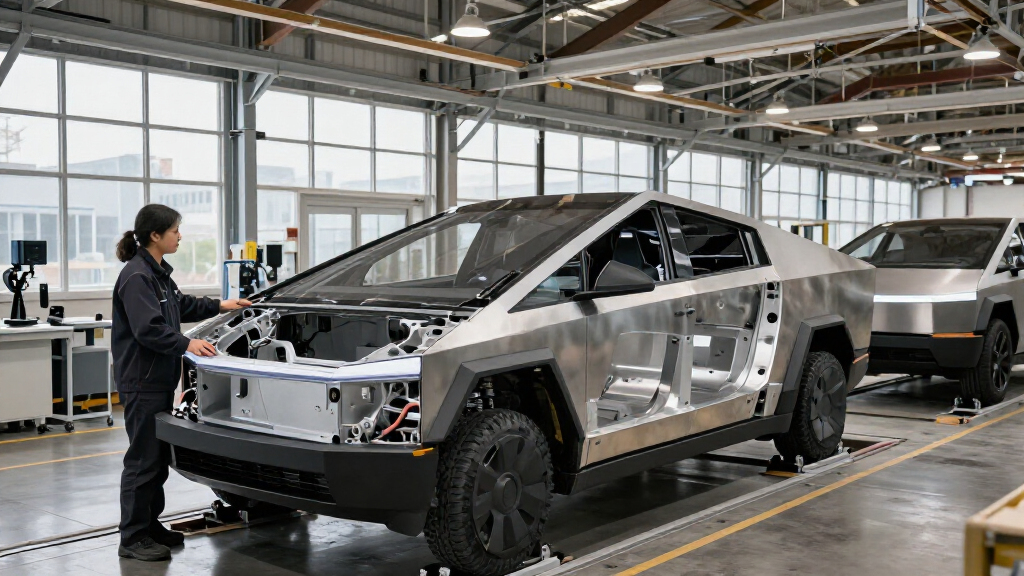
Conventional car production typically builds and paints a vehicle body before installing its wiring, mechanical systems and interior along a long assembly line. Tesla’s “unboxed” approach instead uses separate lines to prepare the front, rear, sides and floor. The modules converge at an automated framing line, where robots position and join them. They arrive with components such as wiring and hoses already in place, reducing the amount of work that must be done inside the completed body.
Tesla engineering chief Lars Moravy and Cybercab lead Eric Earley described the process in the Munro video. The company says the front module contains roughly half the vehicle’s parts and content, including its drive unit, suspension and thermal hardware. Workers can prepare other sections flat or at an accessible height, and fit seats and carpet to the battery pack, whose top cover serves as the cabin floor.
After the modules are joined, the vehicle passes through a final assembly line of about 25 stations. Moravy compared that with roughly five to 10 times as many stations for the Model Y. Tesla also says checks happen at multiple stages: components are tested before they become part of larger assemblies, and systems are checked again as those assemblies are prepared. The front module, for example, arrives with its computers connected and systems checked.
How the Modular Line Changes Assembly
The design shifts work away from installing parts inside a nearly complete vehicle. Smaller sections give workers and robots more direct access, and separate work areas can be placed closer together. If the approach performs as Tesla describes, it could shorten assembly steps and reduce the floor space required for production. Those outcomes are central to the company’s case for building vehicles differently, but the disclosed process does not by itself establish how much time or cost it saves compared with a conventional line.
Surface treatment is another change. The Cybercab’s plastic exterior panels are molded with color, avoiding a conventional paint shop. Tesla says the front and rear structural modules also skip electrocoating, while the steel side structures remain coated. The company says scratches can still be repaired much like those on conventionally painted vehicles. For readers, these choices could affect how the vehicle is made and repaired; real-world repair costs and durability are not detailed in the source material.
Tesla says the line can make up to 125,000 Cybercabs annually at full capacity. That is a stated production capability, not a report of current output. Moravy said the factory does not operate every day because Tesla can build Cybercabs faster than it is deploying them, pointing to a gap between production capacity and the pace of rollout.
Products Worth Considering

DEWALT 20V MAX Brushless 3-Tool Combo Kit with Drill, Impact Driver, Oscillating Multi-Tool, 3 Batteries and Charger (DCK360D3)

Chemical Guys 16-Piece Ceramic Car Wash and Protection Kit with Big Mouth Foam Cannon

Chemical Guys 10-Piece Car Wash Kit with Foam Gun
As an affiliate, we earn on qualifying purchases.
From Tesla’s Automation Challenge
Moravy said the unboxed idea began about six years ago, when Tesla was trying to automate existing vehicle designs and concluded that the design itself was part of the problem. Splitting the vehicle into smaller assemblies was intended to give robots better access and allow stations to sit closer together. The Cybercab line is the company’s current application of that approach, rather than simply a conventional line with more automation added.
Tesla is not the only automaker pursuing modular production. The source report says Ford is developing a related method for its Universal Electric Vehicle platform, which it calls an “assembly tree.” The comparison shows that manufacturers are exploring ways to assemble vehicles in parallel sections, though the source does not provide a direct performance comparison between the companies’ systems.
“The idea began about six years ago, when Tesla was stuck trying to automate existing designs and concluded the problem was the car.”
— Tesla engineering chief Lars Moravy, in a Munro & Associates factory-tour video
Capacity Is Not Current Output
The figures shared by Tesla describe the line’s design and stated potential, not independently verified results. The source does not provide actual Cybercab production totals, unit costs, cycle times, or a quantified comparison of factory space and labor with a conventional line. It is also unclear how quickly Tesla can increase production or deploy vehicles at the pace needed to use the stated 125,000-per-year capacity.
The company’s comments about repairability and staged testing describe the intended process, but the source does not include independent repair assessments or long-term reliability data. Tesla’s statement that factory output currently exceeds deployment does not specify how many vehicles are being made, how many are in service, or what is limiting deployment.
Production and Deployment Milestones
The next measures to watch are reported production and deployment volumes, alongside evidence of how the line performs as output grows. Tesla has said it wants to scale the Cybercab operation, but the source material does not give a schedule for reaching full capacity or a specific date for broader deployment. Its eventual results will show whether the modular process delivers the speed and efficiency Tesla describes.
Tesla CEO Elon Musk set a goal of 5 million annual vehicle deliveries by 2030 on the company’s last earnings call, according to the source report. That is a company target, not a confirmed forecast. Cybercab production is one part of Tesla’s manufacturing plans, and the available information does not establish what share of that goal the vehicle would represent.
Key Questions
What does “unboxed” mean in Cybercab production?
It refers to building the front, rear, side and floor sections on separate lines, then joining them late in production. Much of the wiring and interior work is completed before the sections meet.
How automated is the Cybercab line?
Tesla says the line is about 78% automated. The source does not explain the calculation behind that figure.
How many Cybercabs can the factory build?
Tesla says the line has capacity for up to 125,000 vehicles per year at full production. That is a capacity claim, not a current output figure.
Why does the Cybercab not use a conventional paint shop?
Tesla says its plastic exterior panels are molded with color, allowing it to skip a conventional painting stage. The company says scratches remain repairable, but the source does not include independent repair or durability findings.
Is Tesla already producing Cybercabs at full capacity?
No. The source gives a maximum capacity figure, not current output. Moravy said the factory does not run every day because Tesla can produce vehicles faster than it is deploying them; actual production and deployment totals were not provided.
Source: insideevs.com