To use sound measurements for driveline diagnostics, start by attaching sensors like accelerometers or microphones securely to key components such as the transmission, driveshaft, and differential. As you test drive the vehicle, listen for abnormal noises and analyze vibration patterns. High-pitched sounds often indicate bearing issues, while irregular vibrations can signal worn joints or damaged gears. Continuing will reveal how to interpret these signals for early problem detection and preventive maintenance.
Key Takeaways
- Attach appropriate sensors like accelerometers and microphones securely to critical driveline components for accurate data collection.
- Gradually accelerate the vehicle during testing to simulate real operating conditions and observe authentic sound patterns.
- Record baseline sound and vibration data from a healthy driveline for future comparison.
- Analyze the frequency and pattern of vibrations/noises to identify abnormal signs such as irregular vibrations or unusual sounds.
- Compare current measurements with baseline data regularly to detect early deviations indicating potential driveline issues.
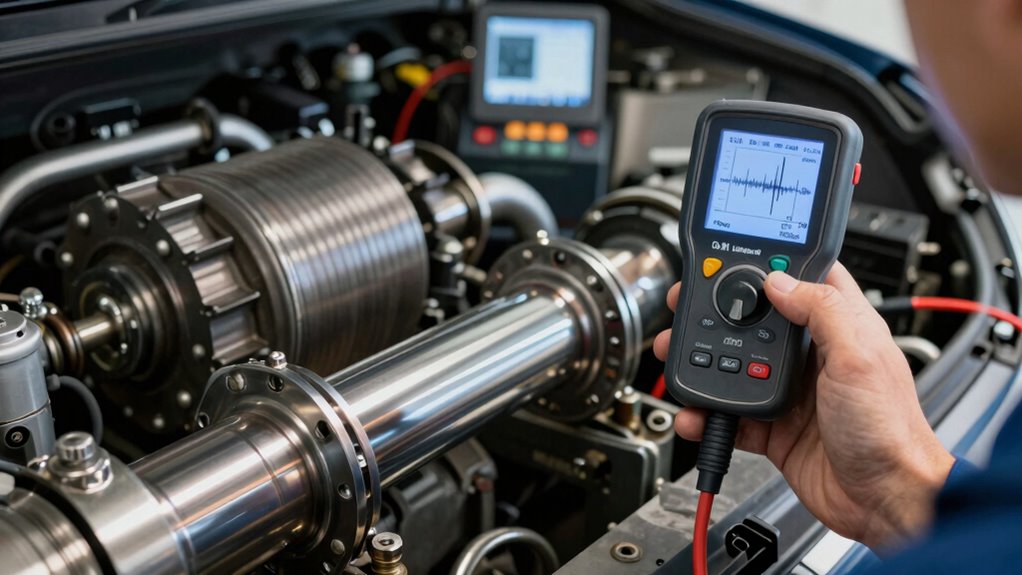
Sound measurements play a crucial role in diagnosing driveline issues by providing real-time insights into mechanical health. When you monitor the sounds produced by your vehicle’s driveline, you gain valuable information about its condition without needing invasive inspections. The key is to analyze vibration patterns and noise frequency to identify potential problems early. Vibration patterns reveal how parts are moving relative to each other, highlighting imbalances, misalignments, or worn components. For example, irregular vibrations or shifts in vibration amplitude can indicate issues such as worn universal joints or damaged gears. Noise frequency, on the other hand, helps you understand the type of defect present. Different faults generate characteristic sounds at specific frequencies. A high-pitched whine might point to bearing failure, while a low-frequency rumble could suggest imbalance or misalignment. By paying close attention to both vibration patterns and noise frequency, you can distinguish between normal operational sounds and abnormal ones that signal trouble.
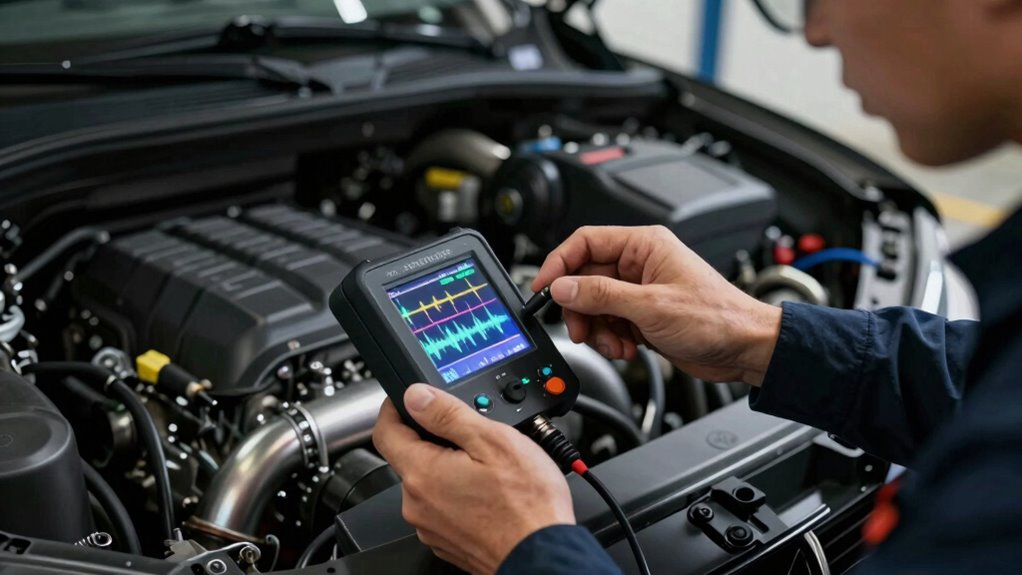
To effectively use sound measurements, you need proper tools like accelerometers, microphones, and frequency analyzers. These devices capture the sound and vibration data, which you then analyze to detect anomalies. When taking measurements, make sure your sensors are securely attached to key points along the driveline, such as the transmission, driveshaft, and differentials. This ensures you gather accurate data and don’t miss subtle changes. During testing, accelerate the vehicle gradually to replicate normal operating conditions, and listen carefully or review the sound data afterward. Look for deviations from baseline vibration patterns and note any unusual noise frequencies. These deviations often precede visible symptoms, giving you a chance to address problems before they worsen. Consistent monitoring and proper data interpretation are key to early detection of driveline issues.
Interpreting the data requires a keen sense of what normal sounds like for your specific vehicle. Keep records of baseline measurements under healthy conditions, so you can compare future readings. Over time, you’ll develop a better understanding of how different issues manifest acoustically. Remember, routine sound measurements can reveal gradual shifts in vibration patterns and noise frequency, alerting you to developing problems. The sooner you detect these signs, the easier and less costly it will be to perform repairs. By integrating sound measurements into your diagnostic process, you enhance your ability to maintain driveline health effectively. This proactive approach minimizes downtime, extends component life, and ensures your vehicle operates smoothly and safely. Utilizing advanced diagnostic tools can further improve accuracy and diagnostic confidence.
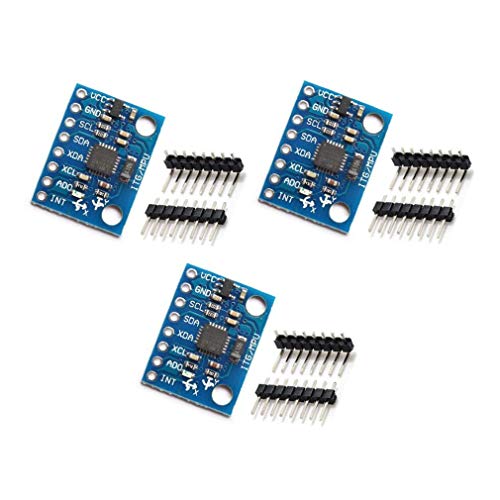
HiLetgo 3pcs GY-521 MPU-6050 MPU6050 3 Axis Accelerometer Gyroscope Module 6 DOF 6-axis Accelerometer Gyroscope Sensor Module 16 Bit AD Converter Data Output IIC I2C for Arduino
- Sensor Type: 6-axis Accelerometer Gyroscope
- Communication Protocol: IIC/I2C
- Data Resolution: 16-bit AD Converter
As an affiliate, we earn on qualifying purchases.
As an affiliate, we earn on qualifying purchases.
Frequently Asked Questions
What Equipment Is Best for Sound Measurement in Driveline Diagnostics?
You should use high-quality accelerometers or ultrasonic sensors for sound measurement in driveline diagnostics. Guarantee proper sensor calibration to get accurate data. These sensors help capture precise vibrations and noise signals. Combine this equipment with effective data analysis techniques, like spectral analysis or time-domain analysis, to interpret the sound data. This approach helps identify issues early, improving maintenance and preventing costly driveline failures.
How Do Ambient Noises Affect Sound Measurement Accuracy?
While ambient noise can subtly influence your sound measurement accuracy, it’s important to guarantee its impact. Environmental sounds, like traffic or machinery, may mask driveline noises, making diagnostics trickier. You can improve accuracy by choosing quieter testing environments, using directional microphones, or applying filters during analysis. These steps help ensure your measurements reflect true driveline conditions, giving you clearer insights and more reliable diagnostics.
Can Sound Analysis Detect All Driveline Issues Reliably?
Sound analysis can detect many driveline issues, but it’s not foolproof. You need to guarantee proper sensor calibration for accurate readings, and noise filtering helps remove ambient sounds that can obscure problem signals. While these techniques improve reliability, some issues might still be missed if they’re subtle or masked by external noise. Regularly calibrate your sensors and apply effective noise filtering to maximize diagnostic accuracy.
How Often Should Sound Measurements Be Performed for Maintenance?
You should perform sound measurements regularly, ideally following your maintenance schedule or every 6 to 12 months. Picture catching a subtle driveline issue before it worsens, saving you costly repairs. Consistent sound measurement frequency ensures early detection of anomalies, helping you maintain ideal performance. Don’t wait for noise complaints—integrate sound analysis into your routine maintenance to keep your driveline running smoothly and reliably over time.
Are There Specific Sound Frequency Ranges Linked to Certain Driveline Faults?
Yes, specific fault frequencies are linked to certain driveline issues within the sound spectrum. You’ll notice that faults like bearing wear or gear damage produce distinct fault frequencies, which appear as peaks in the sound spectrum. By analyzing these frequency ranges, you can identify and diagnose problems early. Pay close attention to anomalies in the fault frequency bands, as they often indicate specific driveline faults requiring maintenance or repairs.

Car Microphone 3.5mm, Car Radio Mic for Pioneer, Kenwood Vehicle Head Unit
- Microphone Type: Mono omnidirectional condenser mic
- Compatibility: Universal 3.5mm/2.5mm car radio compatibility
- Adapter Included: 3.5mm female to 2.5mm male adapter
As an affiliate, we earn on qualifying purchases.
As an affiliate, we earn on qualifying purchases.
Conclusion
Think of your driveline as a musical instrument; when it’s in tune, everything hums smoothly. Sound measurements act as your ear, catching any off-key notes or dissonant chords. By tuning into these subtle signals, you can diagnose issues early, preventing a symphony of breakdowns. With attentive listening and precise measurements, you keep your driveline’s performance harmonious, ensuring your vehicle runs as smoothly as a well-conducted orchestra.
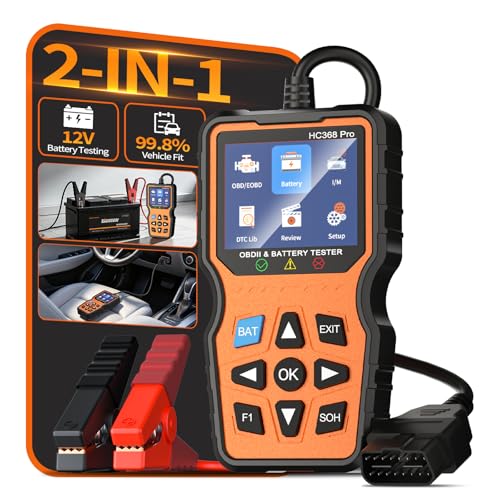
OWMSIC OBD2 Scanner with Battery Tester, 2-in-1 Design 1-Sec Read/Clear Check Engine Code Reader, 12V Car Battery Health & Charging System Analyzer, Universal Auto Diagnostic Tool for 1996+ Cars
- 2-in-1 Fault and Battery Diagnosis: Quickly identify engine and battery issues
- Universal Compatibility: Works with 1996+ OBD2 vehicles worldwide
- Real-Time Data Monitoring: Displays live engine data and emissions status
As an affiliate, we earn on qualifying purchases.
As an affiliate, we earn on qualifying purchases.
![[BLE Vibration Sensor] WTVB01-BT50 Smart Vibration Module Ar-duino, 3-axis Vibration(Amplitude+Frequency+Displacement+Speed) Detector, Wireless Acceleration Shock Motor Monitor](https://m.media-amazon.com/images/I/41va7oLvGmL._SL500_.jpg)
[BLE Vibration Sensor] WTVB01-BT50 Smart Vibration Module Ar-duino, 3-axis Vibration(Amplitude+Frequency+Displacement+Speed) Detector, Wireless Acceleration Shock Motor Monitor
- Integrated 3-Axis Vibration and Temp: Real-time vibration and temperature data
- Long-Range Bluetooth 5.0: 50m transmission, 8-hour battery life
- Universal Smartphone Compatibility: Supports Android and iOS devices
As an affiliate, we earn on qualifying purchases.
As an affiliate, we earn on qualifying purchases.