

Among these car battery testers, I’d place the TOPDON BT200 first for its broad 12V/24V coverage and 100–2000 CCA range. The FOXWELL BT705 stands out for buyers who want battery, alternator, and load testing in one tool, while the KONNWEI KW208 is a straightforward digital choice for routine 12V checks. The main tradeoff is between compact testers that report battery condition quickly and load testers that apply a stronger test but need more care during use. Voltage range, battery chemistry support, and whether you need charging-system checks also separate these options. Read on for the full breakdown and help matching a tester to your vehicle and maintenance habits.

Get business pricing on garage and car supplies
- Business-only prices and quantity discounts
- Tax-exempt purchasing
- Multiple users, one account, clear invoices
Complete the kit


Key Takeaways
- TOPDON BT200 leads for broad coverage: its 12V/24V operation and 100–2000 CCA range suit buyers who need more flexibility than a 12V-only tester.
- FOXWELL BT705 is the most diagnostic-focused pick: battery, alternator, and load testing make it a better fit for troubleshooting than a basic voltage checker.
- Digital conductance testers and load testers answer different questions: compact models such as the KONNWEI KW208 prioritize quick condition readings, while the Yaegoo and TOPDC apply a physical load.
- Several models cover multiple system voltages: the VDIAGTOOL BT500, KINGBOLEN BM550, and OBDResource BR502 add 6V or 24V capability, which matters for less common vehicles and equipment.
- Extra functions can add complexity: the TopDiag T300PRO combines OBD2 scanning with battery testing, but buyers who only need battery checks may prefer a dedicated tester.
| VEHLIVE BT900 Car Battery Tester for 6V and 12V Lead-Acid Batteries |  | Best for Guided Testing | Battery compatibility: 6V and 12V lead-acid | Supported battery types: Flooded, AGM flat, AGM spiral, GEL, EFB | CCA range: 5–3,000 CCA | VIEW LATEST PRICE | See Our Full Breakdown |
| UHANBUT 12V Car Battery and Alternator Tester |  | Best for Simple 12V Checks | Operating voltage: 12V | Measurement type: Voltmeter | Display: LED digital display | VIEW LATEST PRICE | See Our Full Breakdown |
| VDIAGTOOL BT500 6V/12V/24V Automotive Battery Load Tester |  | Best for Mixed-Voltage Lead-Acid Systems | Battery voltage compatibility: 6V, 12V, 24V | CCA range: 5–3,000 CCA | Supported battery types: Flooded lead-acid, AGM flat plate, AGM spiral, GEL, EFB | VIEW LATEST PRICE | See Our Full Breakdown |
| KINGBOLEN BM550 6V/12V/24V Automotive Battery Tester |  | Best for In-Vehicle or Bench Checks | Supported voltage: 6V, 12V, 24V | CCA range: 100–2,000 CCA | Supported battery capacity: 2–220 Ah; enter the battery’s CCA value | VIEW LATEST PRICE | See Our Full Breakdown |
| TOPDON BT200 12V/24V Car Battery Tester, 100–2000 CCA | 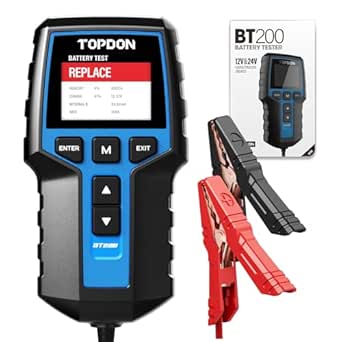 | Best for Deep-Cycle Compatibility | Battery voltage: 12V and 24V | CCA range: 100–2,000 CCA | Compatible battery types: Flooded, AGM, GEL, deep-cycle | VIEW LATEST PRICE | See Our Full Breakdown |
| MOTOPOWER MP0514A 12V Digital Car Battery Tester and Charging System Analyzer |  | Best for Quick Voltage Checks | Compatible systems: 12V vehicle batteries | Measurement type: Voltmeter | Voltage range: 4–20V DC | VIEW LATEST PRICE | See Our Full Breakdown |
| Yaegoo Car Battery Load Tester, 12V 100A / 6V 50A |  | Best for 6V and 12V Load Testing | Compatible voltages: 6V and 12V | Maximum load test: 50A at 6V; 100A at 12V | Maximum battery capacity: 1000 CCA | VIEW LATEST PRICE | See Our Full Breakdown |
| TOPDC 100A Battery Load Tester for 6V and 12V Batteries, 100–1000 CCA |  | Best Analog Load Tester | Battery compatibility: 6V and 12V | CCA range: 100–1000 CCA | Maximum load test: 50A at 6V; 100A at 12V | VIEW LATEST PRICE | See Our Full Breakdown |
| KONNWEI KW208 12V Digital Car Battery Tester |  | Best for Detailed Digital Diagnostics | Battery voltage: 12V | Supported range: 100–2000 CCA | Compatible battery types: Flooded, AGM flat plate, AGM spiral, and gel | VIEW LATEST PRICE | See Our Full Breakdown |
| TOPDON BT100 12V Automotive Battery Tester |  | Best for Broad 12V Battery Compatibility | Battery compatibility: 12V lead-acid | Supported battery types: Flooded, AGM flat plate, AGM spiral, EFB, and gel | CCA range: 100–2000 CCA | VIEW LATEST PRICE | See Our Full Breakdown |
| MOTOPOWER MP0515A 12V Automotive Battery Tester, 100–2000 CCA |  | Best for Straightforward 12V Checks | Model: MP0515A | Operating voltage: 12V | CCA range: 100–2000 CCA | VIEW LATEST PRICE | See Our Full Breakdown |
| FOXWELL BT705 12V/24V Car Battery, Alternator, and Load Tester |  | Best for Mixed-Voltage Vehicles | Model: BT705 | System voltage: 12V and 24V | CCA range: 100–2000 CCA | VIEW LATEST PRICE | See Our Full Breakdown |
| TopDiag T300PRO OBD2 Scanner and 12V Battery Tester |  | Best for Combined Diagnostics | Model: T300PRO | Functions: OBD2 code reader, 6-mode battery analyzer, 16-pin ECU breakout tester | Battery compatibility: 12V flooded, AGM, EFB, and GEL lead-acid batteries | VIEW LATEST PRICE | See Our Full Breakdown |
| OBDResource BR502 Digital Car Battery Tester, 6V/12V/24V, 100–2000 CCA |  | Best Compact Multi-Voltage Pick | Model: BR502 | Battery voltage compatibility: 6V, 12V, and 24V | CCA range: 100–2000 CCA | VIEW LATEST PRICE | See Our Full Breakdown |
| ANCEL BA101 12V Car Battery Tester and Charging System Analyzer |  | Best for 12V Battery-System Checks | Model: BA101 | Battery voltage: 12V | CCA range: 100–2000 CCA | VIEW LATEST PRICE | See Our Full Breakdown |
| car battery tester | CCA range | Display | Dimensions | Weight |
|---|---|---|---|---|
| VEHLIVE BT900 Car Battery Test | 5–3,000 CCA | — | 6.38 × 3.35 × 0.98 in | — |
| UHANBUT 12V Car Battery and Al | — | LED digital display | 4.53 × 2.75 × 0.79 in | 81 g |
| VDIAGTOOL BT500 6V/12V/24V Aut | 5–3,000 CCA | — | 6.45 × 3.35 × 0.96 in | — |
| KINGBOLEN BM550 6V/12V/24V Aut | 100–2,000 CCA | 1.8-inch HD screen | 4.88 × 2.74 × 0.89 in | — |
| TOPDON BT200 12V/24V Car Batte | 100–2,000 CCA | 2.4-inch color LCD | 7 × 3.72 × 1.3 in | — |
| MOTOPOWER MP0514A 12V Digital | — | Four-digit digital LCD | — | 150 g |
| Yaegoo Car Battery Load Tester | — | — | — | — |
| TOPDC 100A Battery Load Tester | 100–1000 CCA | Analog dial | 11.8 × 6.7 × 3.2 inches | 2 pounds |
| KONNWEI KW208 12V Digital Car | — | — | — | 230 g |
| TOPDON BT100 12V Automotive Ba | 100–2000 CCA | — | 5.3 × 3 × 1 in | 9 oz |
| MOTOPOWER MP0515A 12V Automoti | 100–2000 CCA | — | 5.91 × 0.91 × 3.35 inches | 340 g |
| FOXWELL BT705 12V/24V Car Batt | 100–2000 CCA | 2.8-inch screen | — | 325 g |
| TopDiag T300PRO OBD2 Scanner a | — | 2.8-inch TFT color screen | — | 1.1 lb |
| OBDResource BR502 Digital Car | 100–2000 CCA | 1.8-inch HD screen | — | — |
| ANCEL BA101 12V Car Battery Te | 100–2000 CCA | Black-and-white screen with adjustable contrast and white backlight | — | — |
More Details on Our Top Picks
VEHLIVE BT900 Car Battery Tester for 6V and 12V Lead-Acid Batteries
The VEHLIVE BT900 is a strong fit for drivers who want more than a voltage reading: it checks battery health, cranking voltage, charging output, and ripple across several lead-acid battery types. Its color-coded results and guided next steps make those checks easier to interpret than the basic voltage-and-status approach of the UHANBUT 12V Car Battery and Alternator Tester. The 8.2-foot cable is another practical advantage when one person needs to watch the display while checking the charging system. Its 5–3,000 CCA range is broad, but the BT900 stops at 6V and 12V systems; the VDIAGTOOL BT500 and KINGBOLEN BM550 also cover 24V batteries. Skip this model if you need lithium or 24V compatibility, since neither is supported.
Pros:- Checks battery health, cranking, charging output, and ripple.
- Color-coded results and guided next steps help clarify readings.
- 8.2-foot cable makes it easier to view the screen during a charging test.
- Supports flooded, AGM flat, AGM spiral, GEL, and EFB batteries.
Cons:- Does not support 24V systems.
- Not compatible with lithium batteries.
Best for: DIY owners of 6V or 12V lead-acid vehicles who want guided battery, cranking, and charging-system checks without interpreting readings alone.
Not ideal for: Owners of 24V vehicles or lithium-battery systems, because the tester supports neither.
- Battery compatibility:6V and 12V lead-acid
- Supported battery types:Flooded, AGM flat, AGM spiral, GEL, EFB
- CCA range:5–3,000 CCA
- Measurements:Voltage, CCA, internal resistance, cranking voltage, charging voltage, ripple
- Operating voltage:5–16V
- Cable length:8.2 ft (2.5 m)
- Dimensions:6.38 × 3.35 × 0.98 in
- Power source:Battery powered
Our verdict“Choose the BT900 for guided, broad-function testing on 6V or 12V lead-acid batteries, but pick the VDIAGTOOL BT500 if you need 24V coverage.”
UHANBUT 12V Car Battery and Alternator Tester
The UHANBUT 12V Car Battery and Alternator Tester keeps the job simple: it displays voltage, battery health, and charging status on an LED screen. That makes it a straightforward choice for someone who wants a quick indication rather than the broader diagnostic detail available from the VEHLIVE BT900, which also reports cranking voltage, resistance, and ripple. Reverse-connection and over-voltage protection add a useful safeguard, though correct positive and negative clip placement is still required. Its 12V-only design suits many cars, motorcycles, boats, and other listed vehicles, but it cannot serve owners who need 6V or 24V testing like the VDIAGTOOL BT500. I’d choose it for routine checks, not for detailed battery diagnosis or a mixed-voltage workshop.
Pros:- Displays voltage, battery health, and charging status.
- LED display is intended to remain easy to read, including at night.
- Includes reverse-connection and over-voltage protection.
- Listed for use with cars, trucks, motorcycles, boats, off-road vehicles, golf carts, and lawnmowers.
Cons:- Limited to 12V systems.
- Measurement details are narrower than those offered by the VEHLIVE BT900 or VDIAGTOOL BT500.
- Correct positive and negative clip connection is required.
Best for: Drivers and small-equipment owners who need an uncomplicated status and charging check for a 12V battery.
Not ideal for: Owners of 6V or 24V equipment, or buyers seeking CCA, internal-resistance, and cranking measurements.
- Operating voltage:12V
- Measurement type:Voltmeter
- Display:LED digital display
- Protection:Reverse connection and over-voltage
- Compatible vehicles:Cars, trucks, motorcycles, boats, off-road vehicles, golf carts, lawnmowers
- Power source:Battery powered
- Weight:81 g
- Dimensions:4.53 × 2.75 × 0.79 in
Our verdict“Pick the UHANBUT for quick, basic checks on 12V vehicles; choose the VEHLIVE BT900 if you want more diagnostic measurements.”
VDIAGTOOL BT500 6V/12V/24V Automotive Battery Load Tester
The VDIAGTOOL BT500 earns its place through unusually broad voltage coverage: it tests 6V, 12V, and 24V lead-acid batteries, then checks battery condition, cranking, and charging systems. That makes it more adaptable than the VEHLIVE BT900, which stops at 12V, and more diagnostic than the UHANBUT’s basic voltmeter approach. It also operates from the test battery, so no separate charging step is listed, and reverse-polarity and short-circuit protection add practical safeguards. The tradeoff is compatibility: this tester does not work with lithium, deep-cycle, or golf-cart batteries. Accurate results also depend on entering the correct battery type, standard, and CCA value, so it suits owners comfortable supplying those details better than someone seeking a no-setup status check.
Pros:- Tests 6V, 12V, and 24V systems.
- Checks battery load, cranking, and charging systems.
- Measures voltage, resistance, state of health, and state of charge.
- Includes reverse-polarity and short-circuit protection in a shock-resistant ABS housing.
Cons:- Not compatible with lithium, deep-cycle, or golf-cart batteries.
- Correct results depend on entering the battery type, standard, and CCA value.
Best for: DIY mechanics or small garages that service 6V, 12V, and 24V lead-acid vehicles and want battery, cranking, and charging checks in one tool.
Not ideal for: Owners of lithium, deep-cycle, or golf-cart batteries, or anyone unwilling to select the correct battery type, standard, and CCA value.
- Battery voltage compatibility:6V, 12V, 24V
- CCA range:5–3,000 CCA
- Supported battery types:Flooded lead-acid, AGM flat plate, AGM spiral, GEL, EFB
- Tests:Battery load, cranking, charging
- Measurements:Voltage, resistance, state of health, state of charge
- Power source:Powered by the test battery
- Protection:Reverse-polarity and short-circuit
- Dimensions:6.45 × 3.35 × 0.96 in
Our verdict“Choose the BT500 for multi-voltage lead-acid testing across vehicles, but skip it if your equipment uses lithium or deep-cycle batteries.”
KINGBOLEN BM550 6V/12V/24V Automotive Battery Tester
The KINGBOLEN BM550 suits buyers who want to check a battery either in the vehicle or after removing it. It covers 6V, 12V, and 24V systems and reports state of health, charge, voltage, and internal resistance, giving it more diagnostic reach than the UHANBUT’s voltage-focused display. Its 1.8-inch screen keeps results on the tester, while reverse-connection protection helps guard against a common clip mistake. The narrower 100–2,000 CCA range is less expansive than the VDIAGTOOL BT500’s 5–3,000 CCA range, and the BM550 requires the battery’s CCA value for its capacity support. It also does not suit deep-cycle batteries, so the TOPDON BT200 is the better match among these picks for that battery type.
Pros:- Supports 6V, 12V, and 24V batteries.
- Measures state of health, state of charge, voltage, and internal resistance.
- Supports both in-vehicle and out-of-vehicle testing.
- Reverse-connection protection helps guard against incorrect clip connections.
Cons:- Not suitable for deep-cycle batteries.
- CCA range is narrower than the VDIAGTOOL BT500’s.
- Requires entering the battery’s CCA value for capacity support.
Best for: Vehicle owners and repairers who want a compact tester for checking supported batteries both in place and out of the vehicle.
Not ideal for: Owners of deep-cycle batteries or batteries outside the 100–2,000 CCA range, and buyers who do not have the battery’s CCA value.
- Supported voltage:6V, 12V, 24V
- CCA range:100–2,000 CCA
- Supported battery capacity:2–220 Ah; enter the battery’s CCA value
- Compatible battery types:Flooded, AGM flat plate, AGM spiral, GEL, EFB
- Measurements:State of health, state of charge, internal resistance, voltage
- Display:1.8-inch HD screen
- Testing location:In-vehicle or out-of-vehicle
- Dimensions:4.88 × 2.74 × 0.89 in
Our verdict“Choose the BM550 if you need flexible in-vehicle or out-of-vehicle checks across 6V–24V batteries, but pick the TOPDON BT200 for deep-cycle compatibility.”
TOPDON BT200 12V/24V Car Battery Tester, 100–2000 CCA
The TOPDON BT200 is the pick here for buyers who need a tester that explicitly supports deep-cycle batteries alongside flooded, AGM, and GEL types. It checks battery health, cranking, and charging systems, so it offers a fuller picture than the UHANBUT’s simpler voltage-and-status readings. Its 2.4-inch color LCD, memory function, and Good/Replace prompts are aimed at making results easier to review, while support for multiple rating standards helps it serve a range of vehicles and equipment. The tradeoff is that it only covers 12V and 24V, unlike the 6V-capable VEHLIVE BT900, VDIAGTOOL BT500, and KINGBOLEN BM550. Its stated minimum operating voltage is 12V, so it is not the choice for low-voltage testing below that threshold.
Pros:- Supports deep-cycle, flooded, AGM, and GEL batteries.
- Tests battery health, cranking, and charging systems.
- 2.4-inch color LCD, memory function, and Good/Replace prompts aid result review.
- Supports CCA, DIN, JIS, EN, IEC, GB, SAE, MCA, BCI, and CA standards.
Cons:- Does not support 6V batteries.
- Listed minimum operating voltage is 12V.
- CCA range is limited to 100–2,000 CCA.
Best for: Owners of 12V or 24V vehicles and equipment with deep-cycle, flooded, AGM, or GEL batteries who want battery, cranking, and charging-system checks.
Not ideal for: Owners of 6V systems or batteries that need testing below the stated 12V minimum operating voltage.
- Battery voltage:12V and 24V
- CCA range:100–2,000 CCA
- Compatible battery types:Flooded, AGM, GEL, deep-cycle
- Test functions:Battery health, cranking, charging system
- Display:2.4-inch color LCD
- Operating temperature:-4°F to 140°F (-20°C to 60°C)
- Supported standards:CCA, DIN, JIS, EN, IEC, GB, SAE, MCA, BCI, CA
- Dimensions:7 × 3.72 × 1.3 in
Our verdict“Choose the BT200 for deep-cycle testing and clear result prompts on 12V or 24V systems, but choose a 6V-capable model if your battery system requires it.”
MOTOPOWER MP0514A 12V Digital Car Battery Tester and Charging System Analyzer
The MOTOPOWER MP0514A is a straightforward choice when I want a quick voltage reading and a basic check of alternator output, rather than a load test or a detailed battery-health report. Its four-digit LCD gives a precise voltage readout, while eight colored LEDs provide a faster visual cue. That makes it simpler to interpret at a glance than the TOPDC 100A, which uses an analog dial but can apply a load to assess cranking power.
This tester is compact and includes reverse-connection and over-voltage protection, plus a 50 cm extension cable. The tradeoff is its narrow scope: it measures voltage, not CCA, internal resistance, or load performance. I’d choose it for routine checks on a 12V vehicle, but skip it if I need a deeper diagnosis or support for 6V batteries.
Pros:- Checks battery and alternator voltage with one tool.
- LCD readout and colored indicators make voltage status easy to scan.
- Reverse-connection and over-voltage protection are included.
- Lightweight design includes alligator clips and a 50 cm extension cable.
Cons:- Limited to 12V vehicle batteries.
- Voltage-only measurement cannot assess load performance, CCA, or internal resistance.
- Requires direct clip connection to the battery.
Best for: Drivers with a 12V car who want a compact tester for quick battery-voltage and alternator checks.
Not ideal for: Mechanics or owners diagnosing weak cranking who need a load test, CCA readings, or 6V compatibility.
- Compatible systems:12V vehicle batteries
- Measurement type:Voltmeter
- Voltage range:4–20V DC
- Display:Four-digit digital LCD
- Indicators:8 colored LEDs
- Voltage accuracy:0.01V
- Cable length:50 cm extension cable
- Weight:150 g
Our verdict“Choose the MP0514A for simple 12V voltage and charging checks, but pick the TOPDC 100A or another load tester when cranking performance is the concern.”
Yaegoo Car Battery Load Tester, 12V 100A / 6V 50A
The Yaegoo load tester earns its place for buyers who need one tool for both 6V and 12V batteries and want to check battery condition, starter draw, and charging performance. Its load-test capacity reaches 100A on 12V batteries and 50A on 6V systems, making it a broader fit across older vehicles and powersports equipment than the 12V-only MOTOPOWER MP0514A.
The insulated handle, color-coded clip grips, and ventilated case suit hands-on workshop use. Its main compromise is the basic measurement approach: the listed accuracy is ±0.2V, and it doesn’t provide the expanded digital readouts for internal resistance or battery health found on the KONNWEI KW208. I’d favor Yaegoo for direct load testing across two common battery voltages, not for detailed electronic diagnostics.
Pros:- Supports both 6V and 12V batteries.
- Tests battery condition, starter motor draw, and charging system.
- Offers load testing up to 100A at 12V and 50A at 6V.
- Insulated handle, color-coded clip grips, and ventilated case support workshop handling.
Cons:- Maximum load is limited to 50A for 6V batteries.
- Does not list detailed battery-health or internal-resistance measurements.
- Listed voltage accuracy is ±0.2V.
Best for: Owners or repair shops working with a mix of 6V and 12V cars, motorcycles, boats, or RVs who want a direct load test.
Not ideal for: Buyers seeking detailed digital diagnostics, internal-resistance readings, or load testing beyond 100A on 12V systems.
- Compatible voltages:6V and 12V
- Maximum load test:50A at 6V; 100A at 12V
- Maximum battery capacity:1000 CCA
- Voltage accuracy:±0.2V
- Measurement type:Ammeter
- Minimum operating voltage:6V
- Handling features:Insulated carry handle and color-coded rubber-grip clips
- Case:Ventilated
Our verdict“Choose Yaegoo if you need a hands-on load tester for both 6V and 12V systems; choose the KW208 for more detailed digital battery diagnostics.”
TOPDC 100A Battery Load Tester for 6V and 12V Batteries, 100–1000 CCA
The TOPDC 100A suits buyers who want a traditional load test across 6V and 12V batteries, with a dial that shows how voltage responds under load. It covers 100–1000 CCA and can assess cranking power as well as charging-system performance. Compared with the Yaegoo, it shares the 50A 6V and 100A 12V load limits but adds a stated CCA range and a shock-resistant analog meter.
The dial-based format is a tradeoff: it avoids dependence on digital menus, but readings may be less convenient for shoppers who prefer a numerical display like the KONNWEI KW208. Its specified maximum operating voltage is 13.8V, which may constrain the situations where it fits. I’d pick it for basic, hands-on load checks, not for fine-grained battery-health data or a compact glove-box tool; at two pounds, it is more workshop-oriented.
Pros:- Tests both 6V and 12V batteries across a stated 100–1000 CCA range.
- Checks voltage, cranking power, and charging-system performance.
- Shock-resistant analog meter provides a direct visual reading during a load test.
- Cooling vents, rubber grips, and an insulated handle support workshop use.
Cons:- Analog dial may be harder to read precisely than a digital display.
- Listed maximum operating voltage is 13.8V.
- At two pounds, it is less convenient to carry than compact digital testers.
Best for: DIY mechanics who want an analog load tester for 6V and 12V batteries in cars, boats, motorcycles, RVs, or ATVs.
Not ideal for: Drivers who prefer digital health and CCA readouts, need a lightweight portable tester, or require operation above the listed 13.8V limit.
- Battery compatibility:6V and 12V
- CCA range:100–1000 CCA
- Maximum load test:50A at 6V; 100A at 12V
- Measurement type:Ammeter
- Display:Analog dial
- Operating voltage range:6V minimum; 13.8V maximum
- Weight:2 pounds
- Dimensions:11.8 × 6.7 × 3.2 inches
Our verdict“Choose the TOPDC 100A for straightforward analog load checks across 6V and 12V batteries, but opt for the KW208 if you want detailed digital diagnostics.”
KONNWEI KW208 12V Digital Car Battery Tester
The KONNWEI KW208 is the most information-focused option in this group. It goes beyond voltage to report internal resistance, CCA, capacity, battery health, and charge status, then adds cranking and charging-system tests. That makes it a better fit for diagnosing a questionable 12V battery than the simpler voltage-focused MOTOPOWER MP0514A or the dial-based TOPDC 100A.
It supports flooded, AGM, and gel batteries across a 100–2000 CCA range, and can test batteries in or out of a vehicle. The tradeoff is that it is limited to 12V systems, so Yaegoo and TOPDC are better choices for users who also handle 6V batteries. This is a strong choice for owners who want more diagnostic detail without a separate load-test unit, though it still needs a direct connection to the battery.
Pros:- Reports voltage, internal resistance, CCA, capacity, health, and charge status.
- Tests battery, cranking, and charging systems.
- Supports flooded, AGM flat plate, AGM spiral, and gel batteries.
- Can test batteries in or out of a vehicle and supports up to eight languages.
Cons:- Works with 12V batteries only.
- Requires direct connection to the battery clips.
- Does not provide the high-current load-test capacity of the Yaegoo or TOPDC.
Best for: DIY car owners and small repair shops diagnosing 12V flooded, AGM, or gel batteries and their starting or charging systems.
Not ideal for: People who work with 6V batteries or need a dedicated high-current load tester rather than digital battery diagnostics.
- Battery voltage:12V
- Supported range:100–2000 CCA
- Compatible battery types:Flooded, AGM flat plate, AGM spiral, and gel
- Measurements:Voltage, internal resistance, CCA, AH capacity, battery health, and charge status
- Test functions:Battery, cranking, and charging system
- Testing position:Battery in or out of vehicle
- Languages:Up to 8
- Weight:230 g
Our verdict“Choose the KW208 for detailed digital readings on 12V batteries, but select Yaegoo or TOPDC if 6V compatibility and direct load testing matter more.”
TOPDON BT100 12V Automotive Battery Tester
The TOPDON BT100 is a practical digital tester for buyers who need checks across several common 12V lead-acid battery types. It supports flooded, AGM, EFB, and gel batteries from 100–2000 CCA, with battery-health, cranking, and charging-system tests. Compared with the MOTOPOWER MP0514A, it offers a broader diagnostic picture than voltage and alternator checks alone; compared with the KONNWEI KW208, it adds EFB compatibility and copper clamps with reverse-polarity and spark protection.
Its compact, nine-ounce body and color-coded LEDs make it easy to keep on hand, though it still requires a battery connection to power on. It is limited to 12V systems, so the Yaegoo or TOPDC 100A makes more sense for 6V equipment. I’d choose the BT100 for routine checks across varied 12V vehicles, not for high-current load testing.
Pros:- Supports flooded, AGM, EFB, and gel 12V lead-acid batteries.
- Covers battery health, cranking, and charging-system tests.
- Copper clamps include reverse-polarity prevention and spark protection.
- Compact design uses color-coded LEDs and menu-based operation.
Cons:- Compatible with 12V batteries only.
- Needs a direct battery connection to power on.
- Does not offer the high-current load testing of the Yaegoo or TOPDC.
Best for: Owners of mixed 12V vehicles or equipment who want digital battery, cranking, and charging checks across flooded, AGM, EFB, and gel batteries.
Not ideal for: Users testing 6V batteries or those who need a dedicated high-current load test.
- Battery compatibility:12V lead-acid
- Supported battery types:Flooded, AGM flat plate, AGM spiral, EFB, and gel
- CCA range:100–2000 CCA
- Test functions:Battery health, cranking, and charging system
- Measurement type:Voltmeter
- Weight:9 oz
- Dimensions:5.3 × 3 × 1 in
- Clamp protections:Reverse-polarity prevention and spark protection
Our verdict“Choose the BT100 for compact diagnostics across several 12V battery types, but pick a 6V-capable load tester for older or mixed-voltage equipment.”
MOTOPOWER MP0515A 12V Automotive Battery Tester, 100–2000 CCA
The MOTOPOWER MP0515A suits drivers who want one handheld tool to check battery condition, cranking, and charging performance without moving up to a multi-voltage tester. Its 100–2000 CCA range covers a broad span of 12V car batteries, while the included storage bag keeps the tester and leads together between checks. Compared with the OBDResource BR502, it gives up 6V and 24V compatibility, but focuses its capability on ordinary 12V vehicle batteries. That makes the choice simple for a car owner who does not need coverage for mixed-voltage vehicles. The main limitation is the 12V-only design; the listed maximum operating voltage of 12.29V also leaves little basis for treating it as a wider-voltage tool. It is a practical, focused pick rather than a flexible shop tester.
Pros:- Checks battery, cranking, and charging system performance.
- Supports a broad 100–2000 CCA range.
- Compact 340 g body with an included storage bag.
- Includes an instruction manual and a 2-year manufacturer warranty.
Cons:- Designed for 12V car batteries only.
- Listed maximum operating voltage is 12.29V, limiting its appeal for broader system testing.
Best for: Owners of 12V cars who want battery, cranking, and charging checks in a compact tester with a storage bag.
Not ideal for: People servicing 6V or 24V vehicles, or buyers who need a tester with broader vehicle-voltage coverage.
- Model:MP0515A
- Operating voltage:12V
- CCA range:100–2000 CCA
- Tests:Battery, cranking, and charging system performance
- Power source:Battery powered
- Weight:340 g
- Dimensions:5.91 × 0.91 × 3.35 inches
- Included:Battery tester, storage bag, instruction manual
- Warranty:2-year manufacturer warranty
Our verdict“Choose the MP0515A if you need a focused tester for common 12V car batteries and do not need the BR502’s 6V and 24V support.”
FOXWELL BT705 12V/24V Car Battery, Alternator, and Load Tester
The FOXWELL BT705 is the lineup’s stronger fit for owners or technicians who work across cars and larger 24V vehicles. It checks battery health, cranking, and charging output, then reports CCA, voltage, internal resistance, and state of health on a guided 2.8-inch display. Compared with the 12V-only ANCEL BA101, that 24V support broadens its use to trucks and some fleet equipment; the BA101, by contrast, offers extensive standards support for 12V batteries. The BT705’s 5.9-foot cable helps one person monitor a cranking test from the driver’s seat, and its case suits repeated use. Its tradeoffs are a corded connection to the vehicle battery and lead-acid-only compatibility, so it is not a fit for lithium batteries or cordless testing.
Pros:- Works with both 12V and 24V systems.
- Checks battery health, cranking performance, and charging output.
- Reports CCA, voltage, internal resistance, and state of health.
- Long cable, protective housing, and carrying case support repeated testing.
Cons:- Limited to flooded, AGM, GEL, and EFB lead-acid battery types.
- Requires a corded connection to the vehicle battery.
Best for: DIY mechanics, fleet owners, and technicians who need to test both 12V cars and 24V trucks or equipment with lead-acid batteries.
Not ideal for: Owners of lithium-battery vehicles or anyone seeking a cordless tester for quick checks away from the vehicle.
- Model:BT705
- System voltage:12V and 24V
- CCA range:100–2000 CCA
- Battery types:Flooded, AGM, GEL, EFB
- Measurements:CCA, voltage, internal resistance, state of health
- Display:2.8-inch screen
- Test cable:5.9 ft
- Power source:Corded electric
- Weight:325 g
Our verdict“Pick the BT705 over the 12V-only BA101 if you regularly test 24V vehicles as well as cars and can work with a corded tester.”
TopDiag T300PRO OBD2 Scanner and 12V Battery Tester
The TopDiag T300PRO is less of a dedicated battery tester than a multi-function diagnostic tool with battery checks built in. Alongside tests for state of health, state of charge, CCA, cranking, and alternator output, it reads and clears engine codes and displays live data. That combination can help a DIY mechanic investigate whether a starting complaint sits alongside an engine fault, rather than carrying a separate scanner and tester. Compared with the dedicated FOXWELL BT705, the T300PRO adds OBD2 diagnostics and an ECU breakout function, but the BT705 covers 24V systems and is more directly aimed at battery testing across vehicle types. The T300PRO is limited to 12V batteries and OBD2 gasoline vehicles or 12V motorcycles. Choose it for diagnostic breadth, not for mixed-voltage battery work.
Pros:- Combines battery testing with OBD2 code reading and clearing.
- Checks battery health, charge, CCA, cranking, and alternator voltage.
- Records and plays back live sensor data.
- Plug-and-play operation with a 2.8-inch color screen; no phone app or separate batteries required.
Cons:- Battery testing is limited to 12V lead-acid batteries.
- Vehicle coverage is limited to OBD2 gasoline vehicles and 12V motorcycles.
- Its added diagnostic functions may be unnecessary for buyers seeking only battery checks.
Best for: DIY owners of OBD2 gasoline vehicles who want engine-code and live-data tools alongside 12V battery and charging checks.
Not ideal for: Diesel, non-OBD2, or 24V vehicle owners, and buyers who want a battery tester without extra diagnostic functions.
- Model:T300PRO
- Functions:OBD2 code reader, 6-mode battery analyzer, 16-pin ECU breakout tester
- Battery compatibility:12V flooded, AGM, EFB, and GEL lead-acid batteries
- Battery tests:SOH, SOC, CCA, internal resistance, starter cranking, alternator charging voltage
- Display:2.8-inch TFT color screen
- Vehicle compatibility:OBD2 gasoline vehicles and 12V motorcycles
- Supported protocols:ISO 9141-2, ISO 14230-4 (KWP2000), ISO 15765-4 (CAN), SAE J1850 PWM, SAE J1850 VPW
- Diagnostic features:DTCs, live data, freeze frame, I/M readiness, O2 sensor test, EVAP leak test, VIN lookup, MIL status
- Weight:1.1 lb
Our verdict“Choose the T300PRO if you want one tool for 12V battery checks and OBD2 engine diagnostics, but choose the BT705 for 24V battery testing.”
OBDResource BR502 Digital Car Battery Tester, 6V/12V/24V, 100–2000 CCA
The OBDResource BR502 stands out for covering 6V, 12V, and 24V batteries in a small, battery-powered unit. It measures voltage, internal resistance, state of health, and state of charge, with results shown on a 1.8-inch screen in about two seconds. That makes it more versatile across older vehicles, cars, and trucks than the MOTOPOWER MP0515A, which is limited to 12V car batteries. The BR502 also lists flooded, AGM flat plate, AGM spiral, and gel compatibility, plus reverse-polarity protection to help guard the tester if the clips are connected incorrectly. Its compact design comes with a usability compromise: the clips need a firm, correct connection, and the screen may flicker when clamping is poor. I’d choose it for voltage range, not for display size or guided results.
Pros:- Tests 6V, 12V, and 24V batteries.
- Measures voltage, internal resistance, state of health, and state of charge.
- Displays results in about two seconds.
- Reverse-polarity protection helps guard against incorrect clip connections.
Cons:- The 1.8-inch screen is smaller than the guided display on the FOXWELL BT705.
- The screen may flicker if the clips are not clamped securely.
- Requires correct clip connection for operation.
Best for: Owners and independent mechanics who check a mix of 6V, 12V, and 24V lead-acid batteries and want a compact tester.
Not ideal for: Beginners who want a larger screen or highly guided results, or users who may struggle to secure the battery clips correctly.
- Model:BR502
- Battery voltage compatibility:6V, 12V, and 24V
- CCA range:100–2000 CCA
- Battery types:Flooded, AGM flat plate, AGM spiral, gel
- Measurements:Voltage, internal resistance, SOH, SOC
- Display:1.8-inch HD screen
- Test result time:About 2 seconds
- Power source:Battery powered
- Safety feature:Reverse-polarity protection
Our verdict“Choose the BR502 over the MP0515A if you need 6V or 24V coverage in a compact tester and can make secure clip connections.”
ANCEL BA101 12V Car Battery Tester and Charging System Analyzer
The ANCEL BA101 is a dedicated 12V tester for buyers who want battery, cranking, and charging-system information in one straightforward tool. It reports SOH, SOC, voltage, current, and CCA, supports several common lead-acid battery types, and recognizes a wide set of standards, including JIS, EN, DIN, SAE, and BCI. Its backlit display with adjustable contrast helps with visibility, while built-in electrical protections and copper clamps add reassurance during connection. Compared with the MOTOPOWER MP0515A, the BA101 offers more listed standards and protection features, but it is also specific about battery fit: it is for 12V batteries over 30Ah and does not support lithium. That rules out smaller motorcycle batteries and mixed-voltage work. Buyers must also enter the correct battery type, rating, and temperature for useful readings.
Pros:- Checks battery health and charge, plus cranking and charging systems.
- Supports flooded, AGM, GEL, and EFB batteries and multiple industry standards.
- Backlit display has adjustable contrast.
- Includes reverse-polarity, short-circuit, overcurrent, and overvoltage protection.
Cons:- Does not support lithium or non-12V batteries.
- Not intended for motorcycle batteries below 30Ah.
- Readings depend on entering the correct battery type, rating, and temperature.
Best for: Owners of 12V cars, trucks, boats, or RVs with lead-acid batteries over 30Ah who want charging and cranking checks plus broad standards support.
Not ideal for: Lithium-battery owners, people testing 6V or 24V systems, and motorcycle owners with batteries below 30Ah.
- Model:BA101
- Battery voltage:12V
- CCA range:100–2000 CCA
- Battery types:Flooded, AGM, GEL, EFB
- Battery capacity limitation:Over 30Ah
- Measurements:SOH, SOC, voltage, current, CCA, cranking and charging system
- Supported standards:JIS, EN, DIN, SAE, BCI, GB, CA, MCA, IEC
- Display:Black-and-white screen with adjustable contrast and white backlight
- Protection:Reverse polarity, short circuit, overcurrent, and overvoltage
Our verdict“Choose the BA101 for protected, feature-rich checks on 12V lead-acid batteries over 30Ah, but skip it for lithium, smaller motorcycle, or 24V batteries.”

How We Picked
I ranked these testers by how well their stated capabilities match common buyer needs: checking a battery’s condition, diagnosing charging-system problems, and confirming whether the tool supports the vehicle’s voltage and battery rating. I gave more weight to useful diagnostic coverage and clear fit across vehicle types than to feature count alone. Battery and system voltage coverage, CCA range, test method, display and operating simplicity, and the practical scope of included functions all informed the order.
The leading positions go to testers that balance coverage with a clear purpose. The TOPDON BT200 ranks first for its stated 12V/24V and 100–2000 CCA range; the FOXWELL BT705 follows for buyers who need battery, alternator, and load diagnostics together. More specialized or narrower tools rank lower—not because they cannot suit their users, but because they serve a smaller set of jobs. I also distinguish digital testers from load testers, since their methods and operating demands are not interchangeable.
Factors to Consider When Choosing Car Battery Testers
Before choosing among car battery testers, match the tool to the question you want answered. A quick battery-health check, a charging-system diagnosis, and a load test are related but different jobs. I’d use these factors to avoid paying for functions you will not use—or buying a tester that cannot cover your vehicle.
Match Voltage and Battery Type to Your Vehicle
Start with the vehicle or equipment, not the tester’s feature list. Many passenger cars use a 12V system, while 6V and 24V compatibility can matter for older vehicles, motorcycles, commercial vehicles, or other equipment. Check the battery label and the tester’s supported battery chemistries before buying; voltage support alone does not guarantee compatibility with every battery design. A tester intended for lead-acid batteries may not provide the right test method for a different chemistry. Buyers with several vehicles should favor broader support, while a single-car owner may get a simpler tool by choosing a 12V model. Avoid assuming that a tester’s voltage range describes the full range of batteries it can diagnose.
Understand CCA Range and Battery Ratings
CCA, or cold-cranking amps, is a battery rating tied to its ability to start an engine in cold conditions. A tester’s supported CCA range needs to include the rating printed on your battery; otherwise, the reading may be unavailable or less useful. Do not select a tester solely because its maximum number is high: a broad range matters only if it also suits the batteries you own. Record the battery’s stated rating and enter the correct value when the tool asks for it. Confusing CCA with other rating standards can also skew a result, so follow the tester’s instructions for the label format it requests. If you maintain vehicles with very different batteries, a wider stated range can reduce the need for separate tools.
Choose Between Conductance and Load Testing
Digital conductance testers typically estimate battery condition without placing the same sustained load on the battery as a traditional load tester. They can be convenient for regular checks, but a single reading should not be treated as a full diagnosis of every starting problem. Load testers apply a deliberate electrical demand, which can reveal weakness under load but calls for correct setup, careful timing, and attention to the manufacturer’s instructions. A load test can also be less convenient for casual checks than connecting a compact digital unit. These methods complement rather than replace one another, so think about whether you want quick screening or a more direct load-based check. When symptoms persist, a tester result is a starting point for troubleshooting, not proof that the battery is the only cause.
Decide Whether You Need Alternator and Charging Checks
A battery can be in good condition while the vehicle’s charging system is not, so an alternator test can help separate those problems. If you often troubleshoot no-start complaints or maintain more than one vehicle, combined battery and charging checks can save time. For a buyer who only wants occasional battery-status readings, those extra functions may add little value and create a more involved interface. Check exactly which checks a model claims to perform rather than assuming that the word “analyzer” means full vehicle diagnostics. An alternator check also does not replace a broader electrical diagnosis when wiring, connections, or parasitic drain may be involved. Choose combined testing when it addresses a recurring need, not just because it appears on a longer feature list.
Balance Simplicity Against Diagnostic Range
A tester with more modes can serve more jobs, but it may take longer to learn and may be unnecessary for a driver who wants a quick battery check. A dedicated model can be easier to operate and store; a combined unit may make more sense for a home mechanic who regularly checks charging and starting systems. If you are new to battery testing, prioritize clear prompts, readable results, and straightforward connection instructions over a large set of unfamiliar functions. OBD2 capability is a separate benefit from battery testing: it can expand diagnostics, but it also changes the tool’s purpose and learning curve. Before paying for extra modes, ask which specific maintenance task they will help you perform. Keeping the tool aligned with your routine is often more useful than maximizing the specification list.
Frequently Asked Questions
Can a car battery tester tell me whether I need a new battery?
A tester can provide evidence about battery condition, but its reading should not be the only basis for replacement. Check that you entered the correct battery rating and selected the right battery type, since incorrect settings can distort the result. A low state of charge can also affect a test, so follow the manufacturer’s guidance on whether to charge the battery or test it as-is. If the result is poor, repeat the check under the recommended conditions and look for loose or corroded connections. Persistent starting trouble may also come from the alternator, wiring, or another part of the starting system.
Should I buy a load tester or a digital battery tester?
Choose based on the kind of check you expect to perform. A digital tester is generally the more convenient option for routine screening and quick readings, while a load tester applies an electrical demand that can expose weakness under load. Load testing requires closer attention to the tool’s instructions and test duration. Neither method answers every question about a vehicle’s electrical system, and results can be affected by battery charge and setup. If you mainly want periodic checks, a digital unit may be enough; if you specifically need load-based testing, select a load tester suited to your battery.
Is a 12V-only tester enough if I own more than one vehicle?
It is enough only if every battery you plan to test falls within its supported voltage and battery-type range. A 12V-only model will not cover 6V or 24V systems, which can appear in some older vehicles, commercial vehicles, or other equipment. Check each battery’s label rather than relying on vehicle category alone. Also compare the tester’s CCA range with the ratings of your batteries. If your garage includes different system voltages, a compatible multi-voltage model can be more useful than buying a tool around your most common vehicle.
Do I need alternator testing if I only want to check my battery?
Not necessarily. If your goal is a quick battery-condition check, a dedicated tester may suit you without extra charging-system functions. Alternator testing becomes more useful when a battery repeatedly loses charge or a vehicle has starting or charging symptoms, since it can help distinguish a weak battery from a charging problem. It does not identify every possible cause, such as a poor connection or parasitic drain. Consider how often you troubleshoot those issues before choosing a combined tester, and follow its instructions for conducting each separate test.
Can I use a battery tester on a battery that is still connected to the car?
Many testers are designed to connect at the battery terminals while the battery remains installed, but the permitted setup varies by model. Read the instructions for your specific tester and battery before connecting it, including any requirements about the vehicle being off or electrical accessories being switched off. Confirm that the clamps are attached to the correct terminals and avoid allowing them to touch each other. Some test modes may have different connection or safety requirements from a basic check. If the instructions call for disconnecting the battery or taking another precaution, follow that guidance rather than improvising.
Conclusion
For the broadest mix of vehicle coverage and battery ratings, I’d choose the TOPDON BT200 as best overall. The KONNWEI KW208 is my best value-style pick for drivers who want a focused digital 12V check without stepping up to a multi-voltage diagnostic tool. For a more diagnostic-focused setup, the FOXWELL BT705 is the best premium choice in this lineup because it combines battery, alternator, and load testing. Beginners who want a straightforward dedicated tester should look at the TOPDON BT100, while buyers who need 6V or 24V support can compare the VDIAGTOOL BT500, KINGBOLEN BM550, and OBDResource BR502. Choose the TopDiag T300PRO only if OBD2 scanning is part of your plan; otherwise, a dedicated battery tester is the more direct fit.