
The best engine oil is the one that matches your vehicle maker’s required viscosity and oil specification; within that fit, I name Mobil 1 Advanced Full Synthetic 5W-30 my best overall for a broad range of vehicles calling for that grade. For 0W-20 engines, Mobil 1 Advanced Fuel Economy is a focused option, while Valvoline Restore & Protect 5W-30 targets drivers interested in a full synthetic with a cleaning emphasis. The key tradeoff is choosing between conventional, synthetic blend, and full synthetic while keeping the engine’s requirements first. High-mileage formulas may suit older engines, but they do not replace the correct viscosity or a needed repair. Read on for how the 15 options differ and which buyer each one suits.

Get garage and car supplies delivered free — and shop member deals
- Fast, free delivery on millions of items
- Access to Prime Big Deal Days deals on October 6–7
- Prime Video, Amazon Music and more included
Complete the kit


Key Takeaways
- The lineup spans several grades, so there is no single oil that fits every vehicle: match the owner’s manual before comparing formulation or brand.
- The two 0W-20 Mobil 1 options have distinct roles: Advanced Fuel Economy is positioned for fuel-conscious driving, while High Mileage is formulated for older, higher-mileage engines.
- High-mileage choices range from synthetic blends to full synthetics; the vehicle’s required grade and the driver’s priorities determine which tradeoff makes sense.
- Specialized fit matters: Valvoline European Vehicle 5W-40 targets European applications, while Castrol GTX Classic 20W-50 serves only engines that call for that heavier conventional grade.
- Multipacks of Castrol GTX High Mileage 5W-30 can suit owners who routinely use that exact oil, but a larger quantity is less useful when the vehicle’s needs or service schedule may change.



| engine oil | Oil type |
|---|---|
| Mobil 1 Advanced Fuel Economy | Full synthetic |
| Valvoline Advanced Full Synthe | Full synthetic |
| Valvoline High Mileage MaxLife | Synthetic blend |
| Castrol EDGE 0W-20 Advanced Fu | Full synthetic |
| Castrol GTX High Mileage 5W-30 | Synthetic blend |
| Valvoline MaxLife Full Synthet | Full synthetic |
| Castrol GTX Classic 20W-50 Con | Conventional |
| Mobil 1 High Mileage Full Synt | Full synthetic |
| Valvoline Restore & Protect Fu | Full synthetic |
| Castrol GTX High Mileage 10W-4 | Synthetic blend |
| Valvoline European Vehicle Ful | Full synthetic |
| Castrol GTX Full Synthetic 0W- | Full synthetic |
| Mobil 1 Advanced Full Syntheti | Full synthetic motor oil |
| Castrol GTX High Mileage 5W-30 | Synthetic blend motor oil |
| Valvoline Daily Protection SAE | Synthetic blend motor oil |
More Details on Our Top Picks
Mobil 1 Advanced Fuel Economy Full Synthetic Motor Oil 0W-20, 5 Quart
Mobil 1 Advanced Fuel Economy earns this role by pairing a low-viscosity 0W-20 grade with a formulation designed to support engine efficiency. That makes it a focused choice for drivers whose vehicle calls for 0W-20 and who also want oil suited to hybrid use. Compared with Valvoline Advanced Full Synthetic 0W-20, which emphasizes wear, heat, and deposit protection, this Mobil 1 pick puts fuel economy closer to the center of its pitch. Its stated protection interval of up to 15,000 miles may appeal to drivers seeking longer intervals, but the claim is subject to its terms and vehicle needs. I would skip it if the owner’s manual specifies another viscosity or if a high-mileage formulation better suits the engine.
Pros:- 0W-20 formulation designed to support engine efficiency and gas mileage
- Suitable for hybrid vehicles
- Helps protect against sludge
- Advertised protection for up to 15,000 miles, subject to claim terms
Cons:- The extended protection claim depends on its terms and vehicle requirements
- The 0W-20 grade limits its fit to engines that specify or permit that viscosity
Best for: Drivers of vehicles that specify 0W-20, including hybrids, who prioritize engine efficiency and sludge protection.
Not ideal for: Owners whose manuals call for a different viscosity, or drivers specifically seeking a high-mileage blend with seal conditioners.
- Oil type:Full synthetic
- Viscosity grade:0W-20
- Volume:5 quart
- Protection interval:Up to 15,000 miles
- Suitable for:Hybrid vehicles
- Intended benefit:Engine efficiency and gas mileage support
- Deposit protection:Helps fight sludge
Our verdict“Choose this Mobil 1 when your vehicle calls for 0W-20 and fuel economy is a priority, especially for hybrid use.”
Valvoline Advanced Full Synthetic SAE 0W-20 Motor Oil, 5 qt
Valvoline Advanced Full Synthetic 0W-20 is the lineup’s clearest fit for drivers focused on everyday engine protection across cold starts, heat, friction, and deposits. Its low-temperature flow is meant to help oil reach engine components during startup, while its listed API, ILSAC, and manufacturer specifications give buyers concrete compatibility details to check against the owner’s manual. Compared with Mobil 1 Advanced Fuel Economy 0W-20, Valvoline puts more emphasis on wear and deposit defense than on fuel economy or hybrid suitability. The tradeoff is that this product data does not state a long protection interval or specifically call out hybrid use. Its 0W-20 grade also makes it a poor match for engines requiring a different viscosity.
Pros:- Full synthetic 0W-20 formulation
- Designed to flow well at low temperatures for cold-start protection
- Targets wear, friction, heat, and deposits
- Lists current API and ILSAC categories alongside manufacturer specifications
Cons:- No protection interval is provided in the product data
- Does not specifically state hybrid suitability
- Fit depends on the vehicle requiring or allowing 0W-20
Best for: Drivers whose vehicles specify 0W-20 and who want cold-start flow plus stated wear, heat, and deposit protection.
Not ideal for: Owners whose manuals require another viscosity, or buyers seeking a specifically stated extended protection interval or hybrid-focused positioning.
- Oil type:Full synthetic
- Viscosity grade:SAE 0W-20
- Quantity:5 qt
- Standards:ILSAC GF-7A; API SQ, SP, SN with SN PLUS, Resource Conserving, and preceding API and ILSAC gasoline categories
- Ford specification:WSS-M2C962-A1
- Chrysler specification:MS-13340
- GM specification:dexos1 Gen 3
Our verdict“Pick Valvoline Advanced when your 0W-20 engine needs cold-start support and broad everyday protection.”
Valvoline High Mileage MaxLife 10W-30 Synthetic Blend Motor Oil, 5 qt
Valvoline High Mileage MaxLife 10W-30 has a specific job in this roundup: serve engines past 75,000 miles that call for this grade. Its synthetic blend combines seal conditioners, detergents, and friction-fighting additives to address concerns associated with higher-mileage use, including leaks, sludge, deposits, and wear. That makes it a more targeted option than Castrol GTX High Mileage 5W-30, whose 5W-30 grade suits a different set of engine requirements. The compromise is that this is not a general-purpose pick for every newer engine, and its 10W-30 viscosity must match the vehicle’s manual. Drivers with lower-mileage engines or a 5W-30 requirement should look elsewhere in the lineup.
Pros:- Formulated for vehicles with more than 75,000 miles
- Seal conditioners help address oil leaks and consumption
- Detergents target sludge, corrosion, rust, and deposits
- Friction-fighting additives are designed to protect against wear
Cons:- High-mileage focus may be unnecessary for lower-mileage engines
- 10W-30 is unsuitable when the vehicle manual calls for another grade
Best for: Owners of vehicles past 75,000 miles whose manuals specify 10W-30 and who want a blend with seal-conditioning additives.
Not ideal for: Drivers with newer, lower-mileage engines or vehicles that specify 5W-30 or another viscosity.
- Brand:Valvoline
- Viscosity:10W-30
- Oil type:Synthetic blend
- Volume:5 qt (160 fl oz)
- Pack size:1
- Technology:MaxLife
- Standards:ILSAC GF-6A; API SP, SN with SN Plus, and SN
- Manufacturer part number:779462
Our verdict“Choose MaxLife 10W-30 for a higher-mileage engine that calls for 10W-30 and may benefit from seal conditioners.”
Castrol EDGE 0W-20 Advanced Full Synthetic Motor Oil, 5 Quarts
Castrol EDGE 0W-20 stands out for its stated oil-change interval of up to 20,000 miles or one year, whichever comes first, alongside a broad set of listed specifications and approvals. That gives it a clear role for drivers who want to consider longer service intervals while matching the oil to their vehicle’s requirements. Compared with Mobil 1 Advanced Fuel Economy 0W-20, Castrol advertises a longer maximum interval, while Mobil 1 highlights fuel economy and hybrid suitability. The interval is not a universal schedule: vehicle requirements and driving conditions still apply. Buyers should follow the owner’s manual, and drivers whose cars call for another viscosity or a shorter interval should choose accordingly.
Pros:- Full synthetic 0W-20 formulation
- Advertised for up to 20,000 miles or one year between changes
- Lists API and ILSAC specifications plus GM dexos1 Gen 3 approval
- Includes Chrysler and Ford engine test requirements
Cons:- The maximum interval is subject to vehicle requirements and driving conditions
- 0W-20 viscosity does not fit engines requiring another grade
- The extended interval may not suit severe service conditions
Best for: Drivers with 0W-20 vehicles whose manuals permit extended oil-change intervals and whose service conditions support them.
Not ideal for: Owners whose manuals specify shorter intervals or a different viscosity, or who prefer not to rely on an extended-interval claim.
- Viscosity:0W-20
- Oil type:Full synthetic
- Volume:5 quarts
- Oil change interval:Up to 20,000 miles or one year, whichever comes first
- Specifications:Exceeds API SQ, SP, SN PLUS, and SN; ILSAC GF-7
- Manufacturer approval:GM dexos1 Gen 3
- Engine test requirements:Chrysler MS 6395; Ford WSS-M2C947-B1; Ford WSS-M2C962-A1
Our verdict“Consider Castrol EDGE if your 0W-20 vehicle and driving conditions allow the stated extended service interval.”
Castrol GTX High Mileage 5W-30 Synthetic Blend Motor Oil, 5 Quarts
Castrol GTX High Mileage 5W-30 combines a high-mileage focus with attention to sludge control, leak reduction, and emissions-system protection. Its synthetic blend is intended for vehicles over 75,000 miles, and the product data specifically notes phosphorus Replacement Technology to help protect the catalytic converter. Compared with Valvoline High Mileage MaxLife 10W-30, this Castrol uses a different viscosity and calls out emissions-system protection; MaxLife instead highlights its seal conditioners and detergent package. That distinction matters only if the oil grade matches the engine’s requirements. The high-mileage formulation is a poor fit for vehicles outside its intended mileage range, and the listed 12-month manufacturer warranty is not a substitute for checking the manual’s oil specifications.
Pros:- Formulated for vehicles with over 75,000 miles
- Helps control sludge and engine wear
- Seal conditioners are designed to help reduce leaks
- Phosphorus Replacement Technology is intended to protect the catalytic converter
Cons:- High-mileage formulation may not suit lower-mileage vehicles
- 5W-30 grade must match the vehicle’s specified viscosity
- Synthetic blend rather than full synthetic
Best for: Owners of vehicles over 75,000 miles that specify 5W-30 and want a blend designed to address leaks, sludge, and catalytic-converter protection.
Not ideal for: Drivers with lower-mileage vehicles or engines that require a viscosity other than 5W-30.
- Brand:Castrol
- Oil type:Synthetic blend
- Viscosity grade:5W-30
- Size:5 quarts
- Unit count:160 fluid ounces
- Vehicle mileage suitability:Over 75,000 miles
- Specifications:API SP, SN PLUS, SN, and SM; ILSAC GF-6; Ford WSS-M2C946-B1 and WSS-M2C961-A1
- Manufacturer warranty:12 months
Our verdict“Choose this Castrol for a qualifying high-mileage 5W-30 engine when leak and emissions-system concerns matter.”
Valvoline MaxLife Full Synthetic High Mileage 5W-20 Motor Oil, 5 Quart
Valvoline MaxLife is aimed at a specific problem: engines past 75,000 miles that need 5W-20 and may be showing signs of leaks or oil consumption. Its seal conditioners are intended to help address those issues, while the full synthetic formula also targets wear, sludge, heat, and deposits. Compared with Mobil 1 High Mileage 0W-20, this is the better fit when the owner’s manual calls for 5W-20; Mobil 1’s lower-viscosity grade is designed for a different requirement. MaxLife also lists current gasoline oil standards and Ford and Chrysler specifications. Its narrow appeal is the tradeoff: it is not a reason to switch viscosity grades, and seal conditioners cannot repair a worn or damaged engine. Choose it for the specified grade and high-mileage focus, not as a mechanical fix.
Pros:- Seal conditioners are designed to help reduce leaks and oil consumption.
- Full synthetic formula targets wear, sludge, heat, and deposits.
- Designed specifically for engines with 75,000 miles or more.
- Lists ILSAC GF-7A, API SQ, and Ford and Chrysler specifications.
Cons:- Only appropriate when the vehicle calls for 5W-20.
- Seal conditioners cannot fix mechanical wear or damaged seals.
- High-mileage formulation may be unnecessary for newer, low-mileage engines.
Best for: Owners of vehicles with 75,000 miles or more whose manuals specify 5W-20 and who want a full synthetic with seal conditioners.
Not ideal for: Drivers whose vehicles require another viscosity grade, or owners expecting oil additives to repair significant leaks or engine damage.
- Oil type:Full synthetic
- Viscosity grade:5W-20
- Container size:5 quarts
- Designed for:Vehicles with 75,000 miles or more
- Product line:Valvoline MaxLife
- Standards:ILSAC GF-7A; API SQ, SP, SN with SN PLUS, and preceding API and ILSAC gasoline categories
- Additional specifications:Ford WSS-M2C960-A1; Chrysler MS-13340
Our verdict“Choose MaxLife if your high-mileage vehicle specifies 5W-20 and you want a full synthetic formulated to address leaks and consumption.”
Castrol GTX Classic 20W-50 Conventional Motor Oil, 5 Quarts
Castrol GTX Classic 20W-50 serves older and modified gasoline engines that need a thick conventional oil, particularly push-rod and flat-tappet setups. Its high zinc and phosphorus content is intended to limit wear and metal fatigue in performance applications, while resistance to foaming and thermal degradation supports demanding operation. That makes it a very different pick from Valvoline Restore & Protect 5W-30, which targets modern engines and deposit control rather than classic valvetrain needs. The tradeoff is a narrow fit: 20W-50 and API SJ are not current universal choices, and the grade can be unsuitable for engines designed around thinner oil. Buyers should confirm the engine builder’s or manufacturer’s requirements, especially with modified components, before choosing this over a modern multi-vehicle formula.
Pros:- High zinc and phosphorus content is intended for wear protection in flat-tappet applications.
- 20W-50 grade suits engines specifically designed for thicker oil.
- Formulated for collector cars, muscle cars, hot rods, and modified engines.
- Designed to resist foaming and thermal degradation in severe conditions.
Cons:- Narrow 20W-50 viscosity limits compatibility with many modern engines.
- API SJ is an older specification and may not meet newer vehicle requirements.
- Conventional formulation lacks the full synthetic positioning of options such as Valvoline Restore & Protect.
Best for: Owners of classic push-rod or flat-tappet gasoline engines whose manufacturer or builder specifies conventional 20W-50 with elevated zinc and phosphorus.
Not ideal for: Drivers of modern engines requiring a lighter viscosity or newer oil specification, and anyone seeking one oil for varied vehicles.
- Oil type:Conventional
- Viscosity grade:SAE 20W-50
- Volume:5 quarts (160 fluid ounces)
- Compatible engines:Push-rod, flat-tappet, and performance cam applications
- Fuel compatibility:Gasoline and alcohol-based fuels
- Specification:API SJ
- Model number:15E809
- Manufacturer warranty:12 months
Our verdict“Pick GTX Classic for a compatible classic or modified engine that calls for 20W-50 and benefits from its high-zinc formulation.”
Mobil 1 High Mileage Full Synthetic Motor Oil, 0W-20, 5 Quart
Mobil 1 High Mileage 0W-20 combines a high-mileage focus with a low-temperature grade, making it a strong match for older vehicles that still specify 0W-20 and regularly face cold starts. Its full synthetic formula targets friction, sludge, and deposits, and the listing states protection for up to 15,000 miles between oil changes when product guidance is followed. Compared with Valvoline MaxLife 5W-20, Mobil 1 uses a different viscosity and emphasizes cold-start performance; the correct choice depends on the vehicle’s required grade. The extended interval claim should not be treated as a blanket schedule, since service needs and product directions govern the change interval. It is also a poor match for engines calling for 5W-20 or another viscosity, regardless of mileage.
Pros:- 0W-20 grade supports cold-start performance in compatible engines.
- Full synthetic formula is intended for vehicles with 75,000 miles or more.
- Targets friction, sludge, and deposits.
- Meets ILSAC GF-7 standards.
Cons:- Only suitable for engines that specify 0W-20.
- The up-to-15,000-mile protection claim is conditional and does not set every vehicle’s change interval.
- High-mileage additives may offer little targeted benefit in a newer, low-mileage engine.
Best for: High-mileage vehicle owners in cold climates whose manuals specify 0W-20 and who want full synthetic oil with a stated extended protection interval.
Not ideal for: Owners whose engines require a viscosity other than 0W-20, or drivers who want an oil change interval independent of vehicle and product guidance.
- Oil type:Full synthetic
- Viscosity:0W-20
- Size:5 quarts
- Unit count:160 fluid ounces
- Recommended for:Engines with 75,000 miles or more
- Protection interval claim:Up to 15,000 miles between oil changes, subject to product guidance
- Standard:ILSAC GF-7
- Model:Mobil 1 High Mileage
Our verdict“Choose Mobil 1 High Mileage if your older vehicle requires 0W-20 and cold starts are a priority, while following the specified service interval.”
Valvoline Restore & Protect Full Synthetic 5W-30 Motor Oil, 5 Quart
Valvoline Restore & Protect 5W-30 stands apart for its focus on deposits: Active Clean Technology is designed to remove piston deposits over successive oil changes, while Liqui-Shield helps prevent future buildup. That makes it a more targeted choice for drivers who want an ongoing deposit-control approach than Castrol GTX High Mileage 10W-40, which centers on high-mileage sludge and leak control in a synthetic blend. Valvoline also claims 79% stronger anti-wear protection than GF-6 qualified oil; that comparison is the manufacturer’s stated claim, not a guarantee of a specific result in every engine. The payoff depends on regular use, so this is not a quick cleaning treatment. Its 5W-30 grade and listed Ford and Chrysler specs also make manual compatibility a necessary check.
Pros:- Active Clean Technology is designed to remove piston deposits over repeated oil changes.
- Liqui-Shield is intended to help prevent future deposit buildup.
- Full synthetic formulation targets wear protection.
- Lists ILSAC GF-7A, API SQ, and Ford and Chrysler specifications.
Cons:- Deposit removal depends on repeated, regular oil changes.
- The 79% anti-wear figure is a stated comparison with GF-6 qualified oil, not a universal outcome.
- 5W-30 grade may not suit engines that specify another viscosity.
Best for: Drivers whose vehicles specify 5W-30 and who want full synthetic oil formulated for gradual piston-deposit removal and future deposit control.
Not ideal for: Owners seeking an immediate engine-cleaning treatment, or drivers whose manuals require a different viscosity or specification.
- Oil type:Full synthetic
- Viscosity:5W-30
- Volume:5 quarts
- Technology:Active Clean Technology and Liqui-Shield
- Standards:ILSAC GF-7A; API SQ, SP, SN with SN PLUS, and preceding API and ILSAC gasoline categories
- Additional specifications:Ford WSS-M2C961-A1; Chrysler MS-6395
- Anti-wear claim:79% stronger than GF-6 qualified oil, as stated by Valvoline
Our verdict“Choose Restore & Protect if your engine calls for 5W-30 and you want deposit control built into a full synthetic used over successive oil changes.”
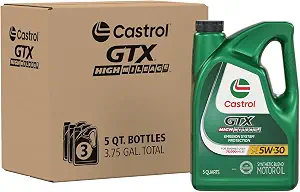
Castrol GTX High Mileage 10W-40 Synthetic Blend Motor Oil, 5 Quarts, Pack of 3
Castrol GTX High Mileage 10W-40 is a synthetic blend for passenger cars, trucks, and SUVs past 75,000 miles, with additives aimed at sludge control, leaks, and engine wear. Its phosphorus replacement technology is designed to help protect the catalytic converter, adding an emissions-system concern to the usual high-mileage priorities. Compared with Valvoline MaxLife Full Synthetic 5W-20, this Castrol is a thicker 10W-40 blend supplied as three 5-quart bottles; it suits a different viscosity requirement and gives buyers multiple containers for routine maintenance. The pack format takes more storage space, and the fuel-economy claim in the product data does not apply to this 10W-40 grade. Check the owner’s manual before choosing it, since high-mileage positioning does not make every viscosity interchangeable.
Pros:- Formulated for vehicles with more than 75,000 miles.
- Additives target sludge, leaks, and engine wear.
- Phosphorus replacement technology is designed to help protect the catalytic converter.
- Three 5-quart bottles provide multiple containers for scheduled maintenance.
Cons:- 10W-40 is unsuitable for engines that specify another viscosity.
- The fuel-economy claim does not apply to the 10W-40 grade.
- Synthetic blend differs from full synthetic options such as Valvoline MaxLife.
Best for: Owners of high-mileage cars, trucks, or SUVs that specify 10W-40 and want a synthetic blend in a multi-bottle pack.
Not ideal for: Drivers whose manuals call for another viscosity, buyers with limited storage, or anyone choosing it specifically for the stated fuel-economy benefit.
- Oil type:Synthetic blend
- Viscosity grade:10W-40
- Container size:5 quarts per bottle
- Pack quantity:3
- Total volume:160 fluid ounces, as listed
- Vehicle compatibility:Passenger cars, trucks, and SUVs; vehicles with over 75,000 miles
- Specifications:API SP, SN PLUS, SN, SM; ILSAC GF-6
- Manufacturer warranty:12 months
Our verdict“Pick this Castrol pack if your high-mileage vehicle specifies 10W-40 and you want a synthetic blend with sludge and emissions-system protection features.”
Valvoline European Vehicle Full Synthetic SAE 5W-40 Motor Oil, 5 qt
Valvoline European Vehicle 5W-40 earns its place through a broad set of listed European manufacturer approvals, including MB-Approval 229.5, VW 502.00/505.00, BMW LL-01, and Porsche A40. That makes it a more targeted choice than Mobil 1 Advanced Full Synthetic 5W-30, which is positioned as a general passenger-car oil and lists a different viscosity. Its detergents and antioxidants are intended to resist deposits and oil breakdown across temperature changes. The tradeoff is that 5W-40 and a long approval list do not make it suitable for every European car: the exact specification in the owner’s manual still decides fit. Buyers with a vehicle requiring one of these listed approvals have a clear reason to choose it; drivers whose manuals call for another grade should pass.
Pros:- Lists approvals and specifications for a range of European gasoline and diesel vehicles
- Full synthetic formulation is designed to protect against wear, heat, friction, and deposits
- Detergents and antioxidants help resist sludge and oil breakdown
- Provides high- and low-temperature protection
Cons:- Compatibility depends on matching the exact vehicle manufacturer requirement
- The 5W-40 grade may not suit engines calling for a thinner or otherwise different oil
Best for: Owners of compatible Audi, BMW, Mercedes-Benz, Volkswagen, or Porsche models whose manuals specify 5W-40 and a listed approval
Not ideal for: Drivers whose vehicle requires another viscosity or manufacturer specification, even if it is a European model
- Brand:Valvoline
- Oil type:Full synthetic
- SAE viscosity:5W-40
- Container size:5 qt (160 fl oz)
- API standard:SP
- ACEA specifications:A3/B3, A3/B4
- Selected manufacturer approvals:MB-Approval 229.5, 229.3, 226.5; VW 502.00/505.00, 505.01; BMW LL-01, LL-14FE+; Porsche A40
- Manufacturer part number:881166
Our verdict“Choose this full synthetic when your European vehicle’s manual calls for 5W-40 and one of its listed approvals.”
Castrol GTX Full Synthetic 0W-20 Motor Oil, 5 Quarts
Castrol GTX Full Synthetic 0W-20 is a fit-focused option for engines that call for this grade and the listed API, ILSAC, GM, or Ford specifications. Its stated protection interval of up to 10,000 miles may suit drivers following a longer service schedule, though the vehicle maker’s interval takes precedence. Compared with Mobil 1 Advanced Full Synthetic 5W-30, Castrol uses a different viscosity and lists GM dexos1 Gen 3 plus Ford specifications, while Mobil 1’s supplied data lists ILSAC GF-7 and a longer stated mileage interval. Castrol’s wear, sludge, and viscosity-breakdown claims speak to routine engine protection, but they do not establish universal compatibility. The main tradeoff is that buyers must verify both the grade and specification before selecting it.
Pros:- Full synthetic 0W-20 formulation for engines requiring that grade
- Lists API SP and ILSAC GF-6 specifications
- Includes GM dexos1 Gen 3 and Ford specifications
- States protection for up to 10,000 miles between oil changes
Cons:- The stated 10,000-mile interval may exceed the service schedule specified for a particular vehicle
- Compatibility depends on matching the vehicle’s required specification as well as its viscosity
Best for: Owners of vehicles requiring 0W-20 that match the listed API, ILSAC, GM dexos1 Gen 3, or Ford specifications
Not ideal for: Drivers whose manuals call for another viscosity or a specification not listed for this oil
- Brand:Castrol
- Oil type:Full synthetic
- Viscosity:0W-20
- Quantity:5 quarts
- Stated protection interval:Up to 10,000 miles
- API specifications:SP, SN PLUS, SN
- ILSAC specification:GF-6
- Selected vehicle specifications:GM dexos1 Gen 3; Ford WSS-M2C947-B1, WSS-M2C962-A1
Our verdict“Pick Castrol GTX when your vehicle calls for 0W-20 and its listed approvals, and follow the service interval in your manual.”
Mobil 1 Advanced Full Synthetic Motor Oil, 5W-30, 5 Quart
Mobil 1 Advanced Full Synthetic 5W-30 stands apart in this group with a stated protection interval of up to 15,000 miles or one year, whichever comes first. That gives it a longer mileage claim than Castrol GTX Full Synthetic 0W-20, whose listed interval is up to 10,000 miles, but the two oils are different grades and neither interval overrides a vehicle’s manual. Mobil 1 also describes friction reduction, deposit and sludge control, and cold-start performance—features that matter to drivers facing low temperatures or extended service schedules. The listed ILSAC GF-7 standard is useful fit information, but vehicle-specific requirements can still rule it out. Its one-year time limit also means low-mileage drivers may need to change oil before reaching the mileage figure.
Pros:- Full synthetic 5W-30 formulation
- States protection for up to 15,000 miles or one year, whichever comes first
- Designed to reduce friction and help control sludge and deposits
- Offers cold-start and low-temperature performance
Cons:- The one-year limit can require an oil change before reaching the stated mileage
- Vehicle-specific fit may exclude engines requiring another viscosity or specification
Best for: Drivers whose manuals specify 5W-30 and ILSAC GF-7, especially those whose manufacturer permits the stated extended interval
Not ideal for: Owners whose engines require a different viscosity or approval, or whose service schedule calls for earlier changes
- Brand:Mobil 1
- Oil type:Full synthetic motor oil
- SAE viscosity grade:5W-30
- Volume:5 quarts (160 fl oz)
- Stated protection interval:Up to 15,000 miles or 1 year, whichever comes first
- ILSAC standard:GF-7
- Flash point:230 °C
- Vehicle type:Car
Our verdict“Choose Mobil 1 if your vehicle specifies 5W-30 and allows its stated extended protection interval.”
Castrol GTX High Mileage 5W-30 Synthetic Blend Motor Oil, 5 Quarts, Pack of 3
Castrol GTX High Mileage 5W-30 is the lineup’s targeted choice for passenger cars, trucks, and SUVs with more than 75,000 miles. Its synthetic blend is formulated to help control sludge and leaks, while the product description also points to catalytic-converter protection. That gives it a different purpose from Valvoline Daily Protection 5W-30, which is presented as a general synthetic blend for many gasoline passenger cars and light-duty trucks rather than specifically for higher-mileage engines. The three-bottle pack supplies 15 quarts in total, useful when you want multiple fills on hand, but less convenient if your immediate need is one smaller quantity. Its listed Ford and API/ILSAC specifications still need to match the vehicle’s requirements; mileage alone does not determine oil compatibility.
Pros:- Formulated for vehicles with more than 75,000 miles
- Designed to help control sludge, reduce leaks, and limit engine wear
- Phosphorus Replacement Technology is intended to help protect the catalytic converter
- Three 5-quart bottles provide 15 quarts total
Cons:- Three-bottle pack may be more than needed for a single oil change
- Synthetic blend rather than full synthetic
- Vehicle compatibility still depends on matching the required viscosity and specifications
Best for: Owners of vehicles past 75,000 miles who need 5W-30 meeting the listed API, ILSAC, or Ford specifications and want a multi-bottle supply
Not ideal for: Drivers needing a single bottle, a full synthetic, or an oil grade and approval not listed for this product
- Brand:Castrol
- Oil type:Synthetic blend motor oil
- SAE viscosity grade:5W-30
- Pack size:3 bottles
- Container size:5 quarts per bottle
- Total volume:15 quarts (480 fl oz)
- Compatible vehicle description:Passenger cars, trucks, and SUVs with over 75,000 miles
- Specifications:API SP/SN PLUS/SN/SM; ILSAC GF-6; Ford WSS-M2C946-B1, WSS-M2C961-A1
Our verdict“Choose this pack for a compatible high-mileage vehicle when you want 5W-30 in a three-bottle supply.”
Valvoline Daily Protection SAE 5W-30 Synthetic Blend Motor Oil, 5 Quarts
Valvoline Daily Protection 5W-30 is the straightforward pick for gasoline passenger cars and light-duty trucks whose manuals permit a synthetic blend. It is designed to help reduce wear, friction, sludge, and deposits, with protection in hot and cold conditions. Compared with Castrol GTX High Mileage 5W-30, it is aimed at everyday use rather than vehicles specifically past 75,000 miles, and it comes as one 5-quart bottle instead of a three-bottle pack. That makes its role clearer for buyers looking to match a general-use blend to a compatible engine. The limitation matters: the description says it is not intended as a full synthetic and recommends it for vehicles that do not require one. Check the manual before choosing it, especially for engines with strict oil requirements.
Pros:- 5W-30 synthetic blend intended for many gasoline passenger cars and light-duty trucks
- Designed to help reduce engine wear and friction
- Detergents help fight sludge and deposits
- Formulated for protection in hot and cold temperatures
Cons:- Not a full synthetic oil
- The description limits its recommendation to vehicles that do not require full synthetic
- The supplied product details do not list specific API or manufacturer approvals
Best for: Drivers of gasoline passenger cars or light-duty trucks whose manuals allow a 5W-30 synthetic blend
Not ideal for: Owners whose vehicles require full synthetic oil, another viscosity, or an approval not specified in the product details
- Brand:Valvoline
- Oil type:Synthetic blend motor oil
- SAE viscosity grade:5W-30
- Container size:5 quarts
- Volume:160 fl oz
- Item weight:9.4 lb
- Container type:Bottle
- Manufacturer part number:779461
Our verdict“Choose Valvoline Daily Protection for routine 5W-30 service when your manual permits a synthetic blend.”

How We Picked
I compared the listed oils by viscosity grade, formulation, and intended application, then judged how clearly each serves a distinct buyer. Full synthetics, synthetic blends, and conventional oil have different positioning, but none earns a higher place simply for being a more elaborate formulation. A correct match to the vehicle maker’s viscosity and specification comes first; a product that does not fit the application is not a sensible choice, regardless of its other attributes.
The order favors broad everyday usefulness within the stated grade, followed by focused options for fuel economy, high-mileage engines, European applications, or routine maintenance. I also weighed practical tradeoffs such as a specialized viscosity, a blend rather than a full synthetic, and multipack quantity. Product names and listed descriptions support these comparisons, but they do not establish unprovided performance test results or approvals, so buyers should confirm the current container’s specifications against their manual.
| engine oil | Oil type |
|---|---|
| Mobil 1 Advanced Fuel Economy | Full synthetic |
| Valvoline Advanced Full Synthe | Full synthetic |
| Valvoline High Mileage MaxLife | Synthetic blend |
| Castrol EDGE 0W-20 Advanced Fu | Full synthetic |
| Castrol GTX High Mileage 5W-30 | Synthetic blend |
| Valvoline MaxLife Full Synthet | Full synthetic |
| Castrol GTX Classic 20W-50 Con | Conventional |
| Mobil 1 High Mileage Full Synt | Full synthetic |
| Valvoline Restore & Protect Fu | Full synthetic |
| Castrol GTX High Mileage 10W-4 | Synthetic blend |
| Valvoline European Vehicle Ful | Full synthetic |
| Castrol GTX Full Synthetic 0W- | Full synthetic |
| Mobil 1 Advanced Full Syntheti | Full synthetic motor oil |
| Castrol GTX High Mileage 5W-30 | Synthetic blend motor oil |
| Valvoline Daily Protection SAE | Synthetic blend motor oil |
Factors to Consider When Choosing Best Engine Oils
Use these checks to narrow the field before choosing a bottle. They help prevent common mismatches that a brand name or formulation label cannot resolve.
Start With the Required Viscosity and Specification
Check the owner’s manual or the manufacturer’s service information for the required viscosity and oil specification. The numbers and letters on the bottle describe performance characteristics and operating ranges, so choosing a different grade because it seems thicker or newer can be a mistake. Some engines also require an industry or automaker approval beyond the viscosity label. Confirm that the exact product and current formulation meet that requirement rather than relying on a familiar product family name. If the manual lists more than one permitted grade, use its temperature guidance for your climate. When the requirement is unclear, ask a qualified service professional before buying.
Choose Formulation for the Vehicle, Not the Label
Conventional, synthetic blend, and full synthetic oils are different formulation categories, but the label alone does not tell you what your engine needs. Follow any synthetic requirement or recommendation in the manual, particularly if the vehicle has a specific service interval or operating condition. A blend can be a reasonable match where the vehicle allows it, while a full synthetic may be required or preferred for another application. Do not assume that paying for a more premium-sounding formulation compensates for a wrong grade. Compare the actual specifications on the container with the vehicle’s requirements. The better choice is the formulation that meets those requirements and suits your maintenance routine.
Treat High-Mileage Formulas as a Targeted Option
High-mileage oils are aimed at older or higher-mileage engines, but mileage alone does not diagnose an engine problem. First check whether the product’s viscosity and approvals match the vehicle. A high-mileage label does not mean the oil will fix leaks, restore worn components, or replace inspection and repair. Consider your engine’s condition, service history, and the manual’s guidance before switching from a standard formula. If the vehicle runs well on its current specified oil, a label change may not provide a clear reason to alter course. Ask a mechanic about persistent oil consumption or leaks instead of relying on an oil change to solve them.
Match Oil Choice to Driving Conditions
Think about the conditions the vehicle actually sees: frequent short trips, heavy loads, extreme temperatures, or long highway drives can affect maintenance needs. Use the vehicle maker’s severe-service definition, since everyday driving can count as severe service for some schedules. Do not extend oil-change intervals solely because a bottle says full synthetic; follow the vehicle’s maintenance system or manual. A driver with a demanding routine may need more frequent changes even when using a premium formulation. Keep a record of the oil grade and service date so future maintenance stays consistent. If operating conditions change, review the service schedule rather than guessing at a new interval.
Weigh Quantity and Buying Convenience
A five-quart container may suit a vehicle whose oil capacity is close to that amount, but check the specified fill quantity before buying. Some engines need less or more, and the oil filter change can affect the service fill. Multipacks can be convenient for a household that repeatedly maintains vehicles requiring the same grade and specification. They can also leave you with excess oil if the vehicle changes or the product no longer matches its requirements. Store opened or spare oil according to the container instructions and keep it sealed from dirt and moisture. Choose quantity around your service plan, not just the apparent convenience of a larger package.
Pay More Only for a Relevant Difference
Before choosing a specialized oil, identify the feature that matters to your vehicle: a required European specification, a permitted high-mileage formula, or a grade suited to a particular application. A premium label is useful only when its listed specifications and intended use align with the manual. Compare product data sheets when the container does not show enough detail, especially for automaker approvals. Avoid choosing by brand loyalty alone when another listed product is a closer match. If two oils meet the same required specification, maintenance timing and correct fill may matter more to your decision than marketing claims. Let fit and documented requirements guide any extra spend.
Frequently Asked Questions
Can I use 0W-20 or 5W-30 if my manual specifies the other grade?
Use the grade specified by your vehicle maker unless its guidance explicitly permits an alternative for your engine and conditions. The oils in this roundup include several grades, but they are not interchangeable just because they share a brand or formulation type. Check the manual’s viscosity chart and any required oil specification. Climate guidance in the manual may allow different grades in some vehicles, while others call for one specific grade. If the recommendation is unclear, verify it with a dealer or qualified mechanic before filling the engine.
Is a high-mileage oil a good choice if my engine does not leak?
It may be an option if the grade and specifications match your vehicle, but high mileage by itself does not make it necessary. Check the manual and compare the product’s listed requirements with your current oil. These formulas are intended for higher-mileage applications, yet the label does not guarantee a repair or a benefit for every older engine. If your engine has no symptoms and runs well on its specified oil, there may be little reason to switch. Seek a diagnosis for leaks, unusual oil consumption, or warning lights.
Does full synthetic oil let me wait longer between oil changes?
Not on its own. Follow the oil-change interval in your owner’s manual, maintenance monitor, or service schedule, including any shorter interval for severe use. The listed full synthetic products differ in grade and intended audience, but their category does not override the vehicle’s schedule. Frequent short trips, towing, dusty conditions, and other demanding use can affect service timing. Keep receipts or a maintenance log so you can track the oil used and the next due service.
Should I buy a multipack of the same high-mileage oil?
A multipack can make sense when you maintain a vehicle that consistently requires that exact viscosity and specification. Confirm the engine’s fill quantity and service interval before estimating how much you will use. If you service more than one vehicle, verify each one separately; a shared brand or high-mileage label does not mean they take the same oil. Extra stock may become inconvenient if you sell the car or its maintenance needs change. Store remaining containers as directed and check their condition before use.
How do I choose between an oil aimed at European vehicles and a general-purpose option?
Start with the vehicle’s manual, which may list a particular automaker approval or oil specification. The Valvoline European Vehicle 5W-40 is presented for European applications, while general-purpose products in this lineup cover other grades and uses; the names alone do not prove a fit. Match the approval and viscosity printed on the current container to the requirements for your exact engine. A general-purpose oil is suitable only if it meets those same requirements. When the manual’s specification is unfamiliar, ask a service professional to confirm it before purchase.
Conclusion
For an engine that calls for 5W-30, I put Mobil 1 Advanced Full Synthetic forward as the best overall pick for broad everyday use. The lineup’s best value depends on vehicle fit: Valvoline Daily Protection 5W-30 is a practical blend to compare when the manual permits it, while drivers seeking a premium synthetic can look at Valvoline Restore & Protect 5W-30 if its specifications match. Beginners should begin with the owner’s manual and choose the listed grade and approval before weighing brand or oil type. For specific needs, compare Mobil 1 Advanced Fuel Economy 0W-20 for a qualifying 0W-20 engine, Valvoline European Vehicle 5W-40 for a matching European specification, and the high-mileage formulas for older engines that call for their grades. The right bottle is the one that meets your vehicle’s requirements and your service plan.
Halloween Picks
halloween
As an affiliate, we earn on qualifying purchases.