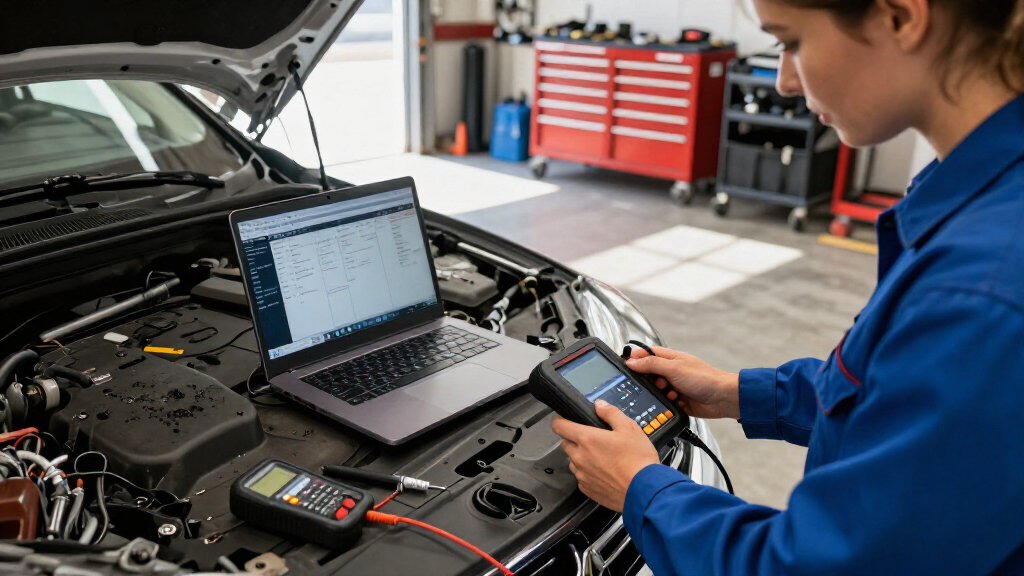

This checklist is for DIYers and small garage operators who want a practical starting point for automotive diagnosis and troubleshooting. It covers common diagnostic tools, including scan and circuit testing, temperature checks, and fuel pressure service.

Get business pricing on garage and car supplies
- Business-only prices and quantity discounts
- Tax-exempt purchasing
- Multiple users, one account, clear invoices
The sections are organized by tool type. Product picks appear where supplied; the multimeter and battery tester sections offer selection guidance without naming a product.
Start with the jobs you handle most often, then check that each tool supports the vehicle systems and tests you need. Confirm connectors, included accessories, and operating ranges against your vehicle and service information before buying.
OBD2 Scan Tool
A scan tool helps you retrieve diagnostic information through a vehicle’s OBD2 connection, making it a useful first step when investigating a warning light or drivability concern. The listed pick is the Autel MaxiCheck MX808S OBD2 Scan Tool with Bidirectional Testing and 2. The product name identifies bidirectional testing, but the supplied details do not specify supported makes, model years, systems, or the included items after “and 2.” Verify those details with the seller before choosing it.
A common mistake is assuming that every scan tool can communicate with every vehicle system or perform every available test. Match the tool’s stated coverage to the year, make, and model you work on, and distinguish basic code reading from any additional functions you expect to use. Check whether its connector and software support your vehicles, and whether the bidirectional functions apply to the components you intend to test. Use vehicle service information to confirm that a commanded test is appropriate. A scan result is a diagnostic clue, so avoid treating a code by itself as proof that a particular part has failed.
What to look for:
- Confirm coverage for your vehicle’s year, make, and model.
- Check which systems and functions are explicitly supported.
- Verify what the product name’s truncated “and 2” refers to.
- Confirm connector compatibility and included accessories.
- Match bidirectional functions to the tests you plan to perform.
Autel MaxiCheck MX808S OBD2 Scan Tool with Bidirectional Testing and 28+ Service

The Autel MaxiCheck MX808S is a versatile automotive diagnostic scanner offering full system diagnostics, bidirectional active tests, and over 28 maintenance services. Designed for both workshops and DIY enthusiasts, it supports vehicles manufactured before 2000 and includes features like auto VIN, live data streaming, and compatibility with various vehicle systems.
Pros:
- Fast performance with Android 11 and powerful hardware
- Supports bidirectional active tests and full system diagnostics
- Includes over 28 maintenance services for comprehensive repairs
- User-friendly with auto VIN and quick auto scan features
Cons:
- Auto VIN feature not universal to all vehicles
- Compatibility varies; check vehicle compatibility before purchase
- Some advanced functions may require additional support or subscriptions
Best for: DIYers seeking a scan tool with bidirectional testing.
Not ideal for: Buyers who need confirmed coverage details before selecting a tool.
Bottom line: Verify vehicle coverage and the listed functions before choosing the Autel MaxiCheck MX808S.
Digital Multimeter
A digital multimeter is useful for checking electrical values during diagnosis, so it can help you investigate issues that a scan tool alone cannot resolve. With no specific product supplied for this slot, choose based on the measurements you need and the vehicle circuits you service. Read the instrument’s stated measurement functions, ranges, and safety specifications rather than assuming that a general-purpose meter is suitable for every automotive task.
A common buying mistake is focusing on a long feature list without checking whether the leads, probes, and measurement modes fit the work. Consider access to the terminals you need to reach, and confirm that the meter and accessories are suitable for the circuits and procedures in your service information. Check the input and safety ratings against the intended use, and inspect what comes in the package. For vehicle-specific connectors or back-probing, confirm that compatible accessories are available. Follow the vehicle maker’s procedure when measuring a circuit; incorrect probing can damage components or produce misleading readings. Pick a clear, usable display and controls you can operate comfortably in your workspace.
What to look for:
- Choose measurement functions and ranges that match your intended checks.
- Review input and safety ratings for the planned automotive use.
- Check lead length, probe type, and accessory compatibility.
- Confirm the display and controls are comfortable to use.
- Follow vehicle service procedures for connection and measurement.
Battery Load Tester
A battery load tester is intended for battery testing, making it a useful addition when battery condition is part of the diagnostic question. No product is specified for this section, so first identify the battery types and testing procedures you need to support. The tester’s stated compatibility should match the batteries you service; do not infer support from a generic product description alone.
One common mistake is buying a tester based on a broad claim without checking its supported battery chemistry, voltage, and test method. Compare those specifications with the batteries in your vehicles and the guidance you follow. Check the tester’s connection clamps and cable reach for practical access to battery terminals, along with any operating instructions and safety requirements. Consider whether the unit’s display makes the result easy to read in your garage. Battery test results should be interpreted in context with the vehicle’s charging system and service information, rather than treated as a complete diagnosis on their own. Choose a clearly documented tester that fits the battery work you actually perform, and verify its operating limits before connecting it.
What to look for:
- Confirm compatibility with the battery chemistry and voltage you service.
- Check the supported test method and operating limits.
- Inspect clamp design and cable reach for your battery access.
- Review instructions and safety guidance before use.
- Choose a display and controls suited to your workspace.
Automotive Circuit Tester
A circuit tester can help investigate electrical power and circuit behavior during automotive troubleshooting. The supplied pick is the VDIAGTOOL V500 Pro Automotive Circuit Tester, Power Circuit Probe, Wir; its product name is truncated, so confirm the complete model description and package contents before ordering. Match the tester’s stated capabilities to the circuits and checks you plan to perform.
A common mistake is assuming a probe can safely test every circuit or connector. Check the manufacturer’s stated operating range and intended applications, then compare them with the vehicle’s electrical system and service procedure. Verify whether the probe tip, leads, and any adapters fit the connectors you need to access. Reach matters too: consider whether the supplied cable can get from your work position to the test point without strain. Confirm how the tool indicates results and whether that indication suits your workflow. Use the appropriate wiring information, and avoid probing circuits unless the tester is rated and the procedure calls for it. Favor clear specifications and compatible accessories over assumptions based on the phrase “power circuit probe.”
What to look for:
- Confirm the complete product name and included accessories.
- Check stated operating limits against the circuits you service.
- Verify probe and adapter fit for your connectors.
- Consider lead reach for your typical test locations.
- Follow vehicle wiring information and the tool’s instructions.
VDIAGTOOL V500 Pro Automotive Circuit Tester, Power Circuit Probe, Wire Tracer,

The V500 Pro is an all-in-one automotive electrical diagnostic tool that combines circuit testing, wire tracing, multimeter functions, oscilloscope, and relay testing. It helps technicians and DIYers quickly identify electrical faults, open and short circuits, and component issues, saving time and reducing repair costs.
Pros:
- All-in-one tool combining multiple diagnostic functions
- Fast and accurate detection of electrical faults
- Rotating screen for easy viewing in tight spaces
- Built-in LED flashlight for low-light diagnostics
Cons:
- Complex for beginners without prior electrical knowledge
- Relatively high cost for casual users
- Requires some training to utilize all features effectively
Best for: Users who need a dedicated automotive circuit probe.
Not ideal for: Shoppers who need complete specifications before confirming this truncated listing.
Bottom line: Verify the full listing, operating limits, and connector fit before choosing the VDIAGTOOL V500 Pro.
Infrared Thermometer
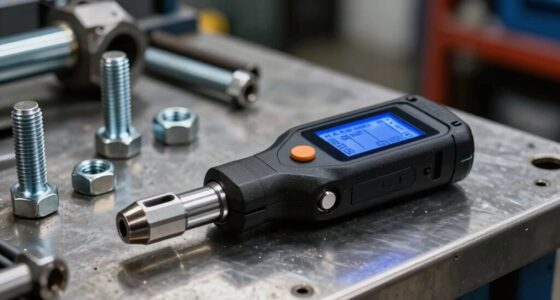
An infrared thermometer provides a way to check surface temperature without placing a contact probe on the measured spot. The listed pick is the Fluke 62 Max Industrial Infrared Thermometer, -22 to +932°F Range, Las. The product name gives a temperature range but is cut off after “Las,” so confirm the full listing and included items. Consider whether a noncontact measurement suits the particular automotive check you intend to make.
A frequent mistake is assuming an infrared reading represents the temperature throughout a component. The reading is for a surface area, and measurement distance, target size, surface condition, and aiming can affect how useful it is. Review the instrument’s stated measurement specifications and instructions, and consider whether you can target the part reliably in the space available. Check that the listed range covers the temperatures relevant to your work, while keeping within the manufacturer’s operating guidance. Avoid using a surface reading as a substitute for a procedure that calls for direct contact or another measurement method. Confirm the targeting guidance and full model details before buying, and compare readings only in a way that fits the tool’s instructions and your service information.
What to look for:
- Confirm the full product listing and package contents.
- Check the temperature range against your intended measurements.
- Review targeting and measurement distance instructions.
- Consider access and target size for the surfaces you will measure.
- Use infrared readings only where the service procedure permits.
Fluke 62 Max Industrial Infrared Thermometer, -22 to +932°F Range, Laser Targeti

This industrial infrared thermometer measures surface temperatures from -22°F to 932°F without contact, suitable for electrical, mechanical, HVAC, and automotive applications. It features laser targeting, a large backlit display, and rugged design for durability and accuracy.
Pros:
- Accurate non-contact temperature measurement
- Laser targeting for precise measurement area
- Durable and rugged design with IP54 rating
- Large backlit display for easy reading
Cons:
- Not suitable for human temperature measurement
- Limited to industrial use only
Best for: Users who need to check accessible surface temperatures.
Not ideal for: Anyone needing a measurement method other than infrared surface readings.
Bottom line: Confirm the full model details and measurement guidance before selecting the Fluke 62 Max.
Fuel Pressure Test Kit
A fuel pressure test kit supports fuel system service when a pressure check is part of the diagnostic procedure. The supplied pick is the OTC 6550PRO Pro Master Fuel Injection Service Kit. The product name indicates a fuel injection service kit, but the provided information does not list its adapters, supported vehicles, or specific test coverage. Check the complete kit contents and compatibility information before purchase.
A common mistake is assuming a kit’s fittings will connect to every vehicle or fuel system. Compare the included adapters with the vehicle’s connection type and follow the manufacturer’s stated application information. Confirm that the kit’s gauge and hoses have appropriate specifications for the test you intend to perform, and check whether any required fittings are sold separately. Consider storage and organization if you expect to use multiple adapters. Fuel system work requires careful attention to the vehicle procedure and the kit instructions; use the specified pressure relief steps and keep connections secure. Select based on verified adapter coverage for your vehicles rather than the broad kit name alone, and consult service information for the correct test conditions and interpretation.
What to look for:
- Review the full adapter list and supported applications.
- Match fittings to the vehicle’s fuel system connections.
- Check gauge and hose specifications for the intended test.
- Confirm whether additional adapters are required.
- Follow fuel pressure relief and test procedures.
OTC 6550PRO Pro Master Fuel Injection Service Kit

This fuel injection service kit allows for fuel pressure testing, diagnosing weak fuel pumps, checking for restricted filters, and performing leak-down tests. It includes a 0-100 psi fuel pressure gauge, 47 adapters with quick connect Schrader valves, and a service application manual.
Pros:
- Comprehensive set with multiple adapters
- Includes a detailed service manual
- Suitable for diagnosing fuel system issues
Cons:
- May be complex for beginners
- Limited to specific vehicle years
- No mention of durability or material quality
Best for: Garages performing fuel pressure checks with verified adapter fit.
Not ideal for: Buyers who cannot confirm the kit’s applications for their vehicles.
Bottom line: Check adapter coverage and test specifications before choosing the OTC 6550PRO kit.
Build your checklist around the jobs you handle most often: identify the vehicle coverage needed for a scan tool, then prioritize electrical or battery testing tools if those checks are part of your work. Add circuit probing, temperature measurement, and fuel pressure testing when the relevant service procedures call for them. This job-first buying order helps you avoid tools whose functions or accessories do not match your vehicles.
Before ordering, compare the full product details with your vehicle information and intended tests, especially where a listing is incomplete. Choose tools you can use confidently and interpret alongside service information. A thoughtful, compatible toolkit can grow one useful diagnostic step at a time.