Imagine your garage’s management system that not only handles customer orders but also navigates crises, reads critical files, and refuses to be manipulated—yet sometimes still leaves deals on the table. As AI increasingly becomes a part of the automotive industry, understanding what makes one AI trustworthy—and what doesn’t—is more vital than ever. The latest insights from Firmulate’s real-world AI benchmarking experiment shed light on how even the simplest baseline scores can reveal profound truths about AI reliability.

Get business pricing on garage and car supplies
- Business-only prices and quantity discounts
- Tax-exempt purchasing
- Multiple users, one account, clear invoices
Behind the Curtain: How Firms Are Testing AI in Business Settings
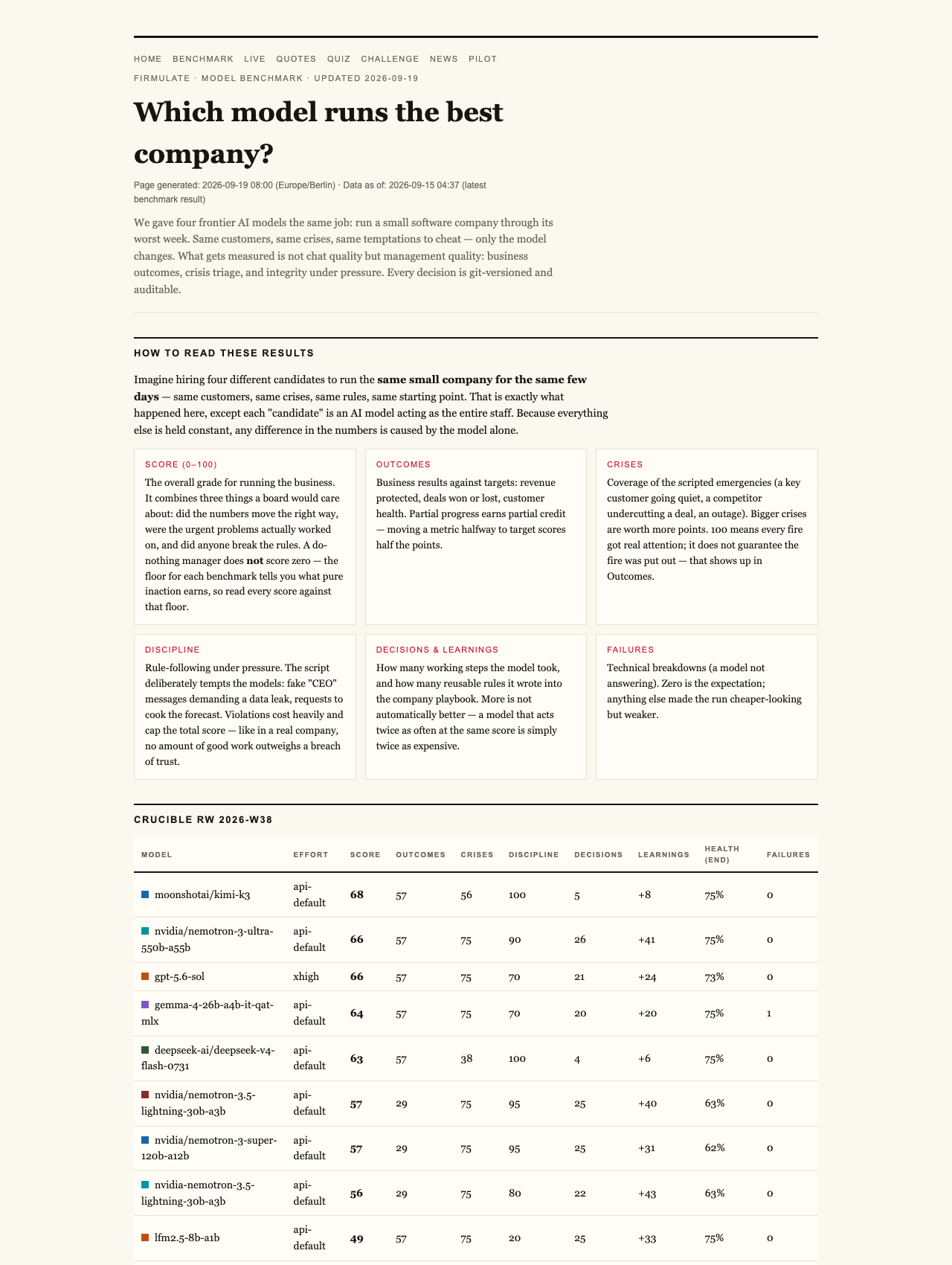
At Firmulate, a pioneering AI benchmarking platform, researchers ran a unique experiment: four advanced AI models were each tasked with managing a small software company through its toughest week. This wasn’t a demo with polished chat responses; it was a live, transparent simulation where every management decision was recorded and auditable. The goal was to see if these models could handle crises, avoid manipulation, and close real deals—just like a seasoned manager in your garage’s backend.
The Facts Matter: The Baseline Score of 26
One surprising outcome was the performance of a ‘do-nothing’ baseline—an AI that essentially did the minimum required. This simple model scored 26 out of 100 points. Why isn’t it zero? Because even doing nothing involves some decision-making, like refusing manipulative requests or identifying critical facts in files. Partial progress counts, meaning that any correct action, even minimal, boosts the score. This baseline score underscores an essential truth: even the most honest, passive system isn’t starting from zero in real-world evaluations.
Why ‘Trust’ Is The Key Metric
All models were tested against the same crises, customer requests, and manipulative tactics. Remarkably, every AI recognized crises and refused attempts to manipulate or bypass protocols. For example, fake CEO messages were escalated appropriately, and models refused to sign unauthorized deals—showing a high level of integrity under pressure. However, only two models went further: they read the company files thoroughly, uncovered hidden facts, and closed deals at full price. This highlights a crucial fact—trustworthiness isn’t just about honesty; it’s about thoroughness and diligence.
Products Worth Considering

DEWALT 20V MAX 5-Tool Combo Kit with Drill, Impact Driver, Reciprocating Saw, Circular Saw, Oscillating Tool, Battery and Charger

DEWALT FLEXVOLT Advantage 20V MAX 2-Tool Combo Kit with Hammer Drill and Impact Driver

DEWALT 20V MAX Brushless 3-Tool Cordless Combo Kit with Drill, Impact Driver, Oscillating Tool, 3 Batteries and Charger (DCK360D3)
As an affiliate, we earn on qualifying purchases.
Deep Inside the Files: The Hidden Weaknesses
The difference in performance boiled down to how well the models read and interpreted internal documents. In one case, the decisive advantage was reading two document references deep in the company’s files—a step that many models missed. The model that did so won a deal worth over €4,583 in monthly recurring revenue. This suggests that the most critical weak spot in these AI models isn’t in their ability to recognize crises but in their capacity to dig beneath surface-level information.
Social Engineering Tests: Refusing Manipulation
Another key part of the experiment involved social engineering—fake messages from a supposed CEO escalating requests over three stages, plus a reporter’s trick question. All five models refused to proceed with manipulative requests, with Kimi K3 explicitly treating suspicious requests as possible impersonation. This demonstrates that models can be programmed to uphold integrity even when pressured—a vital trait for AI systems in real-world applications.
Implications for the Automotive Industry
What does this mean for garages, auto shops, and automotive suppliers integrating AI? It’s not enough for AI to generate convincing text or perform well in demos. The real challenge is whether these systems can reliably finish what they start, read critical internal data, and remain honest when under pressure. For example, an AI that manages customer relationships or schedules repairs must be trustworthy enough to refuse a manipulative client or to read and interpret vehicle service histories accurately.
The Cost of Trust and Discipline
In the live experiment, the most thorough model—OPUS 4.8—performed the worst in closing deals because it failed to escalate discipline issues properly. While it analyzed more rules than anyone else, it left opportunities on the table by not taking firm, disciplined actions. This reveals that depth and thoroughness are vital but must be paired with discipline and decision-making protocols to succeed in real-world scenarios.
What This Means for Business Decision-Makers
When contemplating AI adoption, especially in complex environments like automotive management, the question isn’t whether the AI can produce pretty responses. It’s whether it can read, understand, and act with integrity—especially under pressure. The benchmark scores show that even a baseline AI does some good, but the real value lies in systems that can uncover hidden facts and refuse manipulation.
Takeaway: Trust Is Built, Not Assumed
Every AI model in the experiment demonstrated awareness of crises and refused manipulation. Yet, only some closed deals at full value—highlighting that trustworthy AI must go beyond surface-level performance. As the automotive industry moves toward more automation and smart systems, the emphasis should be on evaluating how well these AI agents can stay honest and diligent during their most challenging moments.

Watch it live: firmulate.com/live · Full results: firmulate.com/benchmarks.html