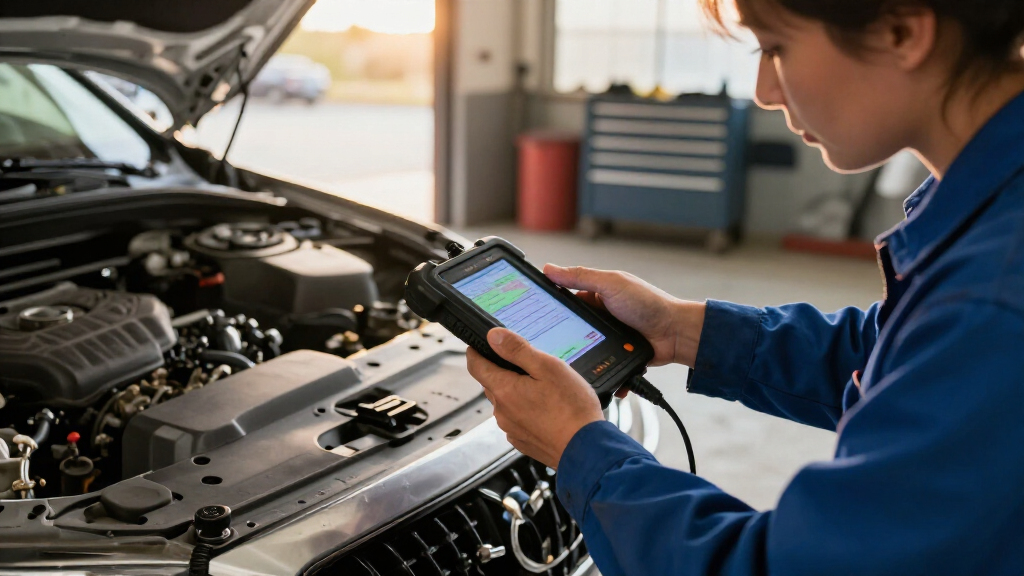

Automotive diagnostic scanners range from inexpensive code readers to advanced workshop tools, so the key choice is how much diagnosis you need to do yourself. A basic OBD-II code reader can retrieve and clear many engine-related trouble codes, display live data, and help explain a warning light. A professional bidirectional scan tool typically reaches more vehicle modules and can command selected components to operate, which helps narrow down faults that a code alone cannot identify.

Get business pricing on garage and car supplies
- Business-only prices and quantity discounts
- Tax-exempt purchasing
- Multiple users, one account, clear invoices

FOXWELL NT604 Elite OBD2 Car Scanner – ABS, SRS & Transmission Diagnostics
- ✔ Supported systems: Engine, transmission, ABS, and SRS
- ✔ Display: 4.3-inch color screen; 480 × 272 resolution
- ✔ Live data: Monitoring with graphing

FOXWELL NT301 OBD2 Scanner Live Data Professional Mechanic OBDII Diagnostic Code Reader Tool
- ✔ Model: NT301
- ✔ Display: 2.8-inch color screen
- ✔ Diagnostics: Reads and clears engine trouble codes

ANCEL AD310 Classic Enhanced Universal OBD II Scanner – Black
- ✔ Model: AD310
- ✔ Supported protocols: KWP2000, J1850 VPW, ISO9141, J1850 PWM, and CAN
- ✔ Vehicle compatibility: 1996+ US and 2000+ EU vehicles; Asian cars, light trucks, and SUVs as supported
The tradeoff is coverage and control against cost and complexity. Drivers who mainly want to understand a check-engine light will usually get more value from a basic reader. Independent mechanics, experienced DIYers, and buyers diagnosing systems such as ABS or airbag faults may justify the professional tool, provided its supported makes, models, and functions match their vehicles.
At a Glance
| Criteria | Basic OBD-II code reader | Professional bidirectional scan tool | Winner |
|---|---|---|---|
| Typical system coverage | Primarily standardized engine and emissions diagnostics | Often includes engine, transmission, ABS, airbag, and other modules; breadth varies by tool and vehicle | B |
| Diagnostic functions | Reads and often clears codes; many models show live data and freeze-frame information | May read enhanced codes, display live data, perform service functions, and run supported active tests | B |
| Ease of use | Simple menus and limited setup | More menus and setup; functions can require vehicle-specific knowledge | A |
| Vehicle compatibility | Broad support for OBD-II engine functions, but often limited by make and model for anything beyond them | Coverage depends on the scanner, software, vehicle, and sometimes paid updates | Depends |
| Cost and ongoing fees | Low upfront cost; some models have no ongoing subscription | Higher purchase price; updates or subscriptions may add ongoing costs | A |
| Best use | Checking a warning light and basic DIY troubleshooting | Repeated, deeper diagnosis in a repair shop or advanced DIY setting | Depends |
FOXWELL NT604 Elite OBD2 Car Scanner – ABS, SRS & Transmission Diagnostics
The NT604 Elite earns the top spot because it reads and clears codes across engine, transmission, ABS, and SRS systems. That broader reach is the meaningful step up from the NT301 and AD310: if an ABS or airbag warning is illuminated, those engine-focused or emissions-focused tools may not provide the relevant code, while the NT604 is designed to access those systems. Its 4.3-inch color display and live-data graphing also make it easier to review information on the tool itself without pairing a phone.There are boundaries to that wider coverage. The NT604 does not offer bidirectional active tests, ECU coding, ABS bleeding, or the listed oil, EPB, SAS, and TPMS service functions. So it can help identify certain faults, but it is not a tool for commanding components or carrying out those maintenance procedures. Coverage also varies by vehicle, which makes checking compatibility especially important for a multi-system scanner. Choose it when reading several major systems is the priority; skip it if you mainly need basic engine codes or expect workshop-level service tools.
Pros:
- Reads and clears codes for engine, transmission, ABS, and SRS systems.
- 4.3-inch color display works without a phone or Bluetooth connection.
- Live-data monitoring with graphing can help put readings in context.
- Free Wi-Fi updates and a protective carrying case are included.
Cons:
- Does not support bidirectional active tests or ECU coding and programming.
- Lacks ABS bleeding, oil reset, EPB, SAS, and TPMS functions.
- Vehicle coverage varies, so compatibility needs to be checked.
Best for: Drivers who want to read engine, transmission, ABS, and SRS codes from one standalone handheld scanner.
Not ideal for: Owners who need bidirectional tests, ECU programming, ABS bleeding, service resets, or guaranteed coverage without checking their vehicle.
Bottom line: We recommend the NT604 Elite when access to several major vehicle systems matters more than service functions or active control.
“We recommend the NT604 Elite when access to several major vehicle systems matters more than service functions or active control.”
FOXWELL NT301 OBD2 Scanner Live Data Professional Mechanic OBDII Diagnostic Code Reader Tool
The NT301 is a focused engine scanner with more context than a basic code reader. Along with reading and clearing engine trouble codes, it shows live data and graphs and provides a one-click I/M Readiness check. That combination makes it more useful than the AD310 when we want to inspect values such as RPM or coolant temperature, or see whether the vehicle reports readiness for an emissions inspection. It also has a 2.8-inch color screen, and it draws power from the OBD2 port.Its narrower system coverage puts it behind the NT604 Elite for buyers dealing with transmission, ABS, or SRS warnings. The smaller screen also gives less room for detailed readings than the NT604’s 4.3-inch display. The NT301’s strength is staying centered on engine diagnostics without requiring a phone or a separate charger; its limits are just as clear. We should choose it for engine codes, live data, and readiness, not for service resets or broader system access.
Pros:
- Reads and clears engine trouble codes.
- Displays real-time data and graphs, including parameters such as RPM and coolant temperature.
- One-click I/M Readiness check simplifies an emissions-readiness review.
- Powered by the vehicle’s OBD2 port and includes free software updates.
Cons:
- Does not provide the NT604 Elite’s listed ABS, SRS, and transmission coverage.
- The 2.8-inch screen is smaller for reviewing detailed data.
- Some advanced functions and vehicle compatibility are vehicle-specific.
Best for: Drivers who want engine-code reading plus live data and a quick readiness check in a handheld device.
Not ideal for: Buyers who need transmission, ABS, or SRS diagnostics, a larger screen, or advanced service functions.
Bottom line: We’d choose the NT301 over the AD310 when live engine data and readiness checks justify a more informative display.
“We’d choose the NT301 over the AD310 when live engine data and readiness checks justify a more informative display.”
ANCEL AD310 Classic Enhanced Universal OBD II Scanner – Black
The AD310 is the straightforward pick for a narrow job: reading and clearing emission-related trouble codes. It supports major OBDII protocols, including CAN, and uses a clear screen with labeled buttons rather than a phone app or wireless setup. Like the other two scanners here, it needs no separate battery or charger. Its 2.5-foot cable gives some reach around the cabin, and its compact, lightweight body suits occasional checks or storage in a glove box.That simplicity also defines its limit. The AD310 cannot read faults outside emission-related diagnostics, so it is less capable than the NT301 for live engine data and readiness checks, and far behind the NT604 Elite for transmission, ABS, and SRS coverage. It is not compatible with OBDI vehicles, even with an adapter. We’d select it when the goal is basic code access and easy controls; buyers who want to investigate broader problems should move up to one of the FOXWELL models.
Pros:
- Reads and clears emission-related codes across major OBDII protocols, including CAN.
- Uses a clear screen and clearly labeled buttons for direct operation.
- Compact, lightweight design with a 2.5-foot cable.
- Requires no separate battery or charger.
Cons:
- Limited to emission-related issues and cannot diagnose other engine faults.
- Does not support OBDI vehicles, even with an adapter.
- Offers less diagnostic information than the NT301 and much less system coverage than the NT604 Elite.
Best for: Drivers who want a simple, cable-connected reader for emission-related OBDII codes on a compatible vehicle.
Not ideal for: Owners who want live data, I/M readiness checks, non-emissions engine diagnostics, or ABS, SRS, and transmission codes.
Bottom line: We recommend the AD310 for basic emissions-code checks when simplicity matters more than live data or wider diagnostics.
“We recommend the AD310 for basic emissions-code checks when simplicity matters more than live data or wider diagnostics.”
As an Amazon Associate we earn from qualifying purchases.
Key Differences
The biggest difference is diagnostic reach. A basic reader is built around standardized OBD-II engine and emissions data, which makes it useful for common check-engine-light questions. It can show a fault code, but that code usually points to a detected condition or circuit; it does not prove which part has failed. A bidirectional scanner may add access to other modules and the ability to command certain components. That can help a technician test a suspected cause instead of replacing parts based on a code alone.
That extra capability only pays off when the vehicle and scanner support the function in question. Coverage is not universal: model year, make, module, software version, and tool tier can all limit access. Professional tools also take more time to learn, and their higher purchase price can be compounded by update fees. For one household car and occasional warning lights, a reader is usually the better value. For regular repair work across several vehicles, broader access and active tests can save diagnostic time and reduce guesswork.
Detailed Comparison
Typical system coverage (Professional bidirectional scan tool wins — major)
Option B wins by a major margin for breadth: professional scanners commonly offer access to more modules, such as ABS or airbag systems, when supported. Option A generally focuses on standardized engine and emissions diagnostics. A driver with a check-engine light may need only A; someone investigating an ABS warning may need B, though coverage must be verified for the exact vehicle.
Diagnostic functions (Professional bidirectional scan tool wins — major)
Option B wins by a major margin when its vehicle-specific functions are available. Both types can retrieve codes, and many basic readers show live data. A bidirectional scanner may also run active tests or support service procedures. Those commands can help isolate a fault, but they are not automatic repairs and require a clear diagnostic purpose. A reader is enough when the goal is simply to see what code appeared.
Ease of use (Basic OBD-II code reader wins — moderate)
Option A wins by a moderate margin for occasional owners. Its smaller set of functions makes basic code retrieval less intimidating. Option B presents more menus and vehicle-specific choices, and interpreting its results takes knowledge. This is a reasonable learning cost for frequent repair work, but a poor trade for someone who only checks a warning light a few times a year.
Vehicle compatibility (moderate difference)
It depends on the vehicle and the exact scanner. Option A often offers straightforward support for standardized OBD-II engine functions, while Option B may cover more makes and modules but can have gaps in specific procedures. Neither label guarantees compatibility. Before buying, check the supported model year, module access, desired function, and whether updates or an account are required.
Cost and ongoing fees (Basic OBD-II code reader wins — major)
Option A wins by a major margin on purchase cost and typically avoids paying for capabilities most owners will not use. Option B costs more and may require software updates or subscriptions to maintain or expand coverage. Those expenses can make sense for a shop that uses the tool repeatedly; for infrequent personal use, the added functions rarely justify the full cost.
Best use (moderate difference)
This is a genuine fit decision. Option A is the sensible choice for checking common engine codes, viewing basic data, and preparing informed questions for a mechanic. Option B suits repeated, multi-system diagnosis and repair tasks where active tests can save time. A home mechanic who works on one car may still prefer B if that car has a specific supported diagnostic need, but should verify it first.
Basic OBD-II code reader: Pros and Cons
Pros:
- Low upfront cost
- Simple for common engine-code checks
- Often adequate for live data and freeze-frame basics
- Useful for deciding whether a warning needs prompt attention or further diagnosis
Cons:
- Usually limited to engine and emissions systems
- A code does not identify a failed part by itself
- Cannot typically command components for active tests
- Advanced functions and manufacturer-specific coverage are limited
Professional bidirectional scan tool: Pros and Cons
Pros:
- Can access more vehicle modules when supported
- May offer active tests and service functions
- Better suited to repeated professional diagnosis
- Can reduce guesswork when paired with sound diagnostic knowledge
Cons:
- Higher purchase price and possible update fees
- More complex to learn and interpret
- Vehicle and function coverage varies by model and software
- Extra features may go unused by occasional owners
Who Should Choose What
Choose Basic OBD-II code reader if:
- You mainly want to read a check-engine light or view basic engine data.
- You own one or two cars and diagnose faults only occasionally.
- You want a low-cost starting point before deciding whether a repair needs a professional.
Choose Professional bidirectional scan tool if:
- You diagnose vehicles regularly for work or advanced DIY repairs.
- You need access to non-engine modules or supported active tests.
- You have confirmed the scanner supports your vehicle and the exact functions you need.
Skip both if: Skip both as a repair solution if you expect a scanner to identify the failed part or fix a safety-critical fault on its own; use scan results as evidence and have complex or urgent problems diagnosed by a qualified mechanic.
Value for Money
Paying more for a professional scanner is worthwhile when broader system access and active tests will be used often enough to save labor or prevent unnecessary parts replacement. That is most plausible for a repair business or a capable DIYer maintaining several compatible vehicles. Check update pricing and function coverage before purchase, since the advertised feature set may depend on software access.
For a typical car owner, a basic reader is usually the better value. It can explain many check-engine warnings and provide information to discuss with a mechanic at a fraction of the cost. If a specific warning involves ABS, airbags, or another module beyond the reader’s reach, paying a shop for diagnosis may cost less than buying a higher-tier scanner that is rarely used.
Final Verdict
Choose a basic OBD-II code reader if your main task is understanding common engine warnings and checking basic data. It is the clear value choice for most drivers. Choose a professional bidirectional scan tool if you diagnose cars regularly, need access to more modules, and have verified support for the vehicles and tests you handle. The deciding factor is repeat use of those advanced functions: without it, the professional tool’s extra cost and complexity are hard to justify.
Frequently Asked Questions
Can a basic OBD-II reader tell me exactly what part is broken?
No. It reports codes and related data that point toward a detected condition. Diagnosis may require checking wiring, sensors, mechanical causes, and other evidence before replacing a part.
Will a professional scanner work with every car?
No. Supported makes, model years, modules, and functions vary by scanner and software. Confirm the exact vehicle and procedure in the manufacturer’s compatibility information before buying.
Is a bidirectional scanner worth it for home use?
It can be, if you regularly work on vehicles and need its supported active tests or service functions. For occasional check-engine-light checks, a basic reader is usually a better buy.
Can either scanner clear a warning light permanently?
A scanner may clear a stored code, but the light can return if the underlying fault remains or is detected again. Clearing codes does not repair the cause.