
You should trend by hours when managing effort, resource allocation, and labor costs, especially in industries where time tracking helps identify bottlenecks and improve efficiency. If your focus is on measurable outcomes and tangible deliverables, then trending by output makes more sense. Both methods provide valuable insights, but choosing the right approach depends on your operational goals. Keep exploring to find out how combining these metrics can optimize your performance even further.
Key Takeaways
- Use hours-based trending when monitoring labor costs, resource utilization, and project efficiency in time-critical or service environments.
- Opt for output-based trending to measure tangible results, productivity, and deliverables in manufacturing or sales-driven sectors.
- Combine both methods for comprehensive insights into efficiency and output quality, especially in complex or high-volume operations.
- Choose hours tracking to optimize staffing levels and reduce idle time in projects with fixed schedules or deadlines.
- Select output metrics to focus on measurable results and ensure resource efforts align with specific productivity goals.
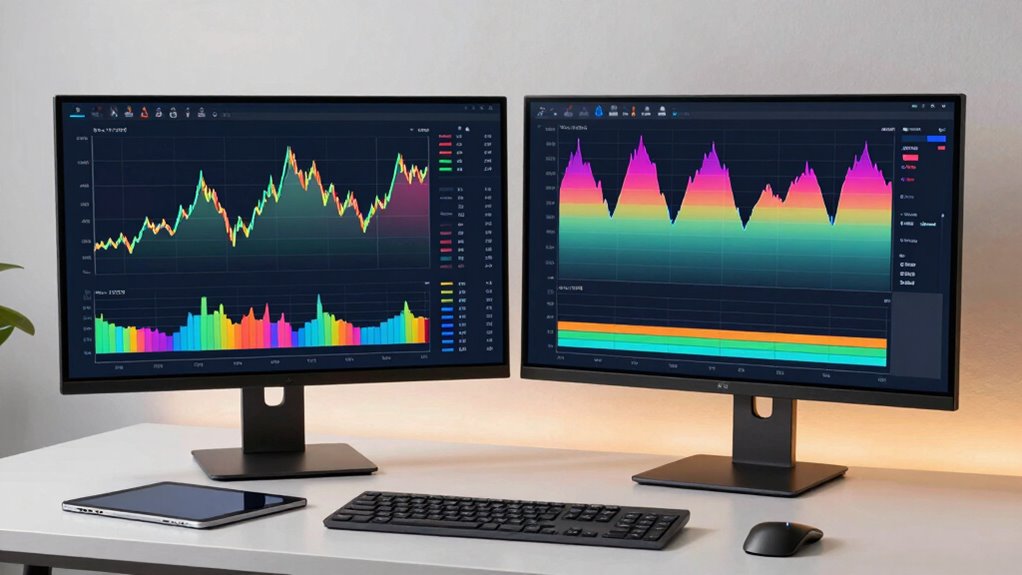
Deciding whether to trend by hours or by output depends on your specific goals and the nature of your operations. This choice directly impacts how you interpret productivity metrics and allocate resources effectively. If your priority is understanding how efficiently your team uses time, then trending by hours makes sense. It allows you to track labor costs, identify bottlenecks, and see how much time is spent on different tasks. This approach is especially useful in environments where time is the most critical factor, such as service industries or complex projects with fixed schedules. By monitoring hours, you get a clear picture of resource allocation, helping you optimize staffing levels and reduce idle time.
Trending by hours helps optimize staffing and reduce idle time in time-sensitive projects.
On the other hand, trending by output is ideal when your main focus is the actual results or deliverables produced. If your business relies on tangible products, completed tasks, or measurable results, then output-based metrics provide a more accurate reflection of productivity. For example, a manufacturing line might track units produced, while a sales team could track closed deals. This approach emphasizes results over effort, encouraging teams to prioritize efficiency and quality. It’s especially useful when resource allocation needs to be aligned with output goals, ensuring that efforts directly contribute to your bottom line.
Choosing between hours and output also depends on your industry and operational structure. In industries where quality and precision matter, such as healthcare or engineering, hours might be more relevant to monitor due to the importance of detailed work and compliance. Conversely, in high-volume production settings or sales-driven environments, output metrics tend to drive better insights into performance and profitability. You’ll want to consider how each method aligns with your strategic objectives—whether you seek to improve time management or increase actual results.
Furthermore, integrating both approaches can give you a balanced perspective. Tracking hours helps identify where inefficiencies exist, while measuring output shows whether those hours are translating into desired results. This dual view enables you to fine-tune resource allocation, ensuring your team is neither overworked nor underperforming. Regularly reviewing these metrics helps you adapt strategies, optimize workflows, and maintain a clear focus on your business goals.
Additionally, understanding how philosophical insights on existence and ethics can influence management strategies and productivity metrics may offer a broader perspective on balancing effort and results. Ultimately, the decision hinges on what you need to measure and improve. If managing costs and efficiency is your priority, trend by hours. If maximizing results and output is key, then focus on output metrics. Understanding the nuances of each approach helps you make informed choices, ensuring your operations are both effective and aligned with your strategic vision.

Employee Time Clock Software and Fingerprint Scanner, Time Attendance Tracker, Unlimited User Profiles, No Monthly Fees, Incl. Support and Updates, Digital 4500 Series Scanner, TimeDrop by LotHill
MULTI-PURPOSE TIME CLOCK SOFTWARE & SCANNER – TimeDrop Employee Time Clock Software with Attendance Tracking, Payroll and Quick…
As an affiliate, we earn on qualifying purchases.
As an affiliate, we earn on qualifying purchases.
Frequently Asked Questions
How Do I Determine the Right Timing for Trend Analysis?
You should determine the right timing for trend analysis by monitoring your performance metrics regularly. Focus on periods when data accuracy is high, ensuring reliable insights. Conduct analysis after completing significant projects or during consistent workflow phases, so you can spot meaningful patterns. Avoid analyzing data during anomalies or incomplete cycles. By aligning your trend timing with accurate, stable data, you’ll make smarter decisions and optimize your performance effectively.
What Tools Are Best for Tracking Output Versus Hours?
You should use tools like Tableau, Power BI, or Excel to track output versus hours, focusing on productivity metrics. These tools help you visualize data clearly through dashboards and charts, making it easier to identify trends and inefficiencies. Regularly updating and reviewing these visualizations guarantees you stay informed about performance, allowing you to make data-driven decisions that improve productivity and optimize resource allocation.
Can Trends Vary Across Different Industries or Job Types?
Absolutely, trends can dance to different tunes across industries and job types. You’ll find that performance metrics and industry benchmarks act like a compass, guiding your understanding of what’s typical. In creative fields, output might be the shining star, while in manufacturing, hours are the steady drumbeat. Recognizing these nuances helps you tailor your analysis, ensuring your insights hit the right note regardless of the industry rhythm.
How Often Should I Review Trends for Accuracy?
You should review your trends regularly, at least weekly, to make certain of accuracy. Keep an eye on productivity benchmarks and use data visualization tools to spot inconsistencies or shifts early. Frequent reviews help you adjust strategies promptly, maintaining reliable data. If your industry or job type is dynamic, consider more frequent checks. Consistent trend analysis ensures your decision-making is based on current, accurate insights, boosting overall efficiency.
What Are Common Mistakes When Choosing Between Hours and Output?
You often mistake using hours for output because you overlook productivity benchmarks and resource allocation. Relying solely on hours can hide actual efficiency, while focusing on output might ignore workload complexity. You should consider both metrics carefully, ensuring your trend analysis reflects true performance. Avoid these common mistakes by aligning your trend method with your specific goals, whether improving productivity or optimizing resource use, for more accurate insights.

Klein Tools ET920 USB Power Meter, USB-A and USB-C Digital Meter for Voltage, Current, Capacity, Energy and Resistance
VERSATILE USB TESTING: Test voltage from 3 to 20V DC and current from 0.05 to 3A (USB-A) and…
As an affiliate, we earn on qualifying purchases.
As an affiliate, we earn on qualifying purchases.
Conclusion
Think of your data like a river—sometimes, flowing steadily by hours captures the current’s subtle shifts, while at other times, measuring by output reveals the torrent’s true strength. Knowing when to navigate by hours or output is like choosing the right vessel for the journey—each offers a clearer view of the landscape ahead. By selecting the right approach, you steer your analysis with confidence, ensuring your insights flow smoothly and accurately, no matter the terrain.

No Subscription GPS Tracker for Vehicles Work with Find My(iOS Only) Real-Time Mini Tracker Tags Global Coverage Hidden Car Location Tracking Tags Device with Magnetic Case No Monthly Fee Required
Mini Size and Magnetic Case:Small (1.37×1.37×0.39 inches) and lightweight,this car GPS tracker with a waterproof magnetic case easily…
As an affiliate, we earn on qualifying purchases.
As an affiliate, we earn on qualifying purchases.
Simhevn Electronic Digital Calipers, inch and Millimeter Conversion,LCD Screen displays 0-6" Caliper Measuring Tool, Automatic Shutdown, Suitable for DIY/Jewelry Measurement (New150mm Black Plastic)
[4 measuring methods and safety]: Digital calipers can be used to measure inner and outer diameters, depths and…
As an affiliate, we earn on qualifying purchases.
As an affiliate, we earn on qualifying purchases.